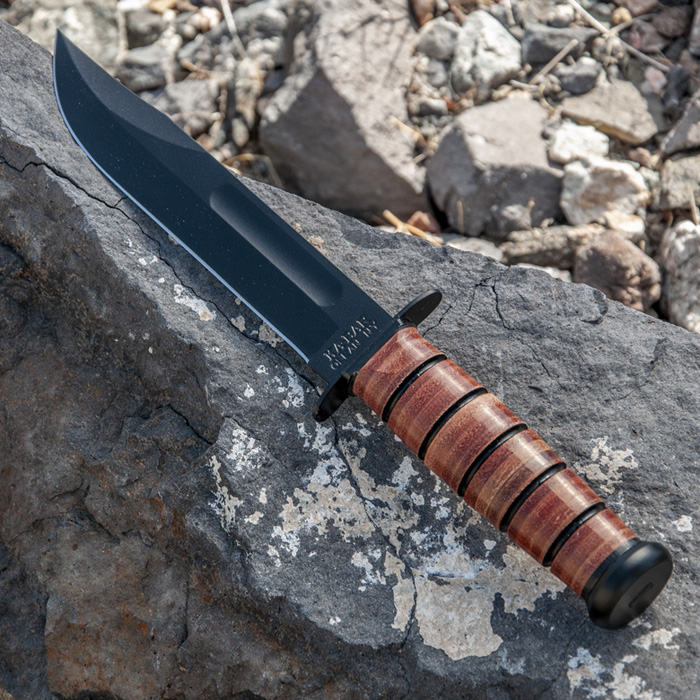
In 1942 the United States Marine Corps needed a knife that could do everything at once: open ration cans, cut parachute cord, pry, dig, hammer with the pommel, and — if it came to it — fight. What the Corps adopted in 1943 was seven inches of carbon steel with a stacked-leather handle and a clip point, and it turned out to be one of those rare designs that got it right on the first try. Eighty-odd years later KA-BAR still makes it in Olean, New York, to the same pattern, and it is still the knife most Americans picture when someone says “combat knife.”
We verify manufacturing against primary sources, read what actual owners report, and never accept payment for rankings.
The specification has barely moved since the war. A seven-inch blade of 1095 Cro-Van, .165 of an inch thick at the spine, hardened to 56–58 HRC, flat ground with a twenty-degree edge. A guard of 12-gauge commercial-grade carbon steel. A handle built from stacked leather washers compressed onto the tang. Eleven and seven-eighths inches overall, about eleven ounces. Tang stamped USMC. It carries a NATO stock number, which is a quiet way of saying the government still buys them.
What follows is not a nostalgia piece. This knife has a real weakness, it is not the one people expect, and the origin story on the box is more complicated than the marketing suggests.
Which one is this, exactly?
KA-BAR’s USMC family is large and the names collapse into each other on retail listings. The knife reviewed here is the one KA-BAR currently calls the KA-BAR® USMC, Straight Edge, item number 1217. Sold with the sheath it is catalogued as 1217S; the sheath is included either way.
The near neighbours, using KA-BAR’s own item numbers:
| Item | What it is | How it differs |
|---|---|---|
| 1217 | USMC, Straight Edge | The issued pattern. Plain edge, leather handle, USMC tang stamp |
| 1218 | USMC, Serrated | Same knife, partially serrated edge |
| 1220 | U.S. Army | Same pattern, Army tang stamp, beige handle |
| 1250 | USMC Short | Shorter blade for lighter carry |
| 1214 | Full-size, Kraton handle | Synthetic handle instead of stacked leather |
Two things follow. If the handle in the photograph is black rubber rather than banded brown leather, you are looking at the Kraton version, not this one — and for wet climates that is arguably the smarter buy. And if the tang stamp matters to you, it is the one specification that is not interchangeable: the Army knife is the same tool with a different stamp, and the Corps knife is not sold with an Army stamp.
What it’s like to use
The balance point sits just behind the guard, which tells you what the knife was designed to do. It is a knife that stabs, slices and pries willingly and chops reluctantly. Owners who buy it as a camp chopper come away lukewarm; owners who use it to process cordage, open things, carve stakes, baton kindling and generally substitute for a small tool kit are the ones who write the five-star reviews.
The stacked-leather handle is the part people either love or quietly replace. It is warm in cold weather, it does not get slick the way a polished synthetic does, and it develops a grip pattern shaped by your own hand over years. It is also organic material clamped around a steel tang, which means prolonged soaking is its enemy. One owner puts the caution plainly: be careful carrying it in the rain, because “the leather washers on the handle will swell and degrade when exposed to constant moisture.” That is correct and it is why KA-BAR sells the same knife with a Kraton handle.
The blade steel is the other thing to understand before buying. 1095 Cro-Van is a high-carbon steel with small additions of chromium, vanadium, nickel and molybdenum — tough, easy to sharpen on almost anything, and not stainless. The black epoxy powder coat protects the flats; the edge you sharpen is bare steel and will rust if you put it away wet. KA-BAR’s own advice is a light coat of mineral oil. Owners who follow it report no corrosion at all across decades; owners who do not, do.
The spine is thick and the grind is flat rather than hollow, so this is not a delicate slicer. It will not take the hair-splitting edge a thin kitchen-style blade will, and it is not trying to. What it will do is survive being used as a pry bar and a hammer by someone who has run out of better ideas, which is exactly the brief the Corps wrote in 1942.
What owners actually say
Across 8,230 ratings the distribution is 93 percent five-star and effectively nothing below three. That is an extraordinarily thin band of criticism, and we will not manufacture more of it than exists. But the criticism that does exist is consistent enough to be worth taking seriously, and it is not about the design.
The real complaint is the factory edge, and it varies wildly unit to unit. This is the one thing to check the day it arrives. A large share of owners rave that it came shaving sharp — “razor sharp out of the box,” “I make knives as a hobby… very few have come with a shaving edge, this one did.” But a persistent minority describe the opposite, and describe it in detail. One reports the blade “arrived highly dull. I’m talking not even slightly sharp.” Another, sharpening it himself, found “the blade had been very poorly ground” with the bevel much heavier on one half than the other. A third describes an edge that “snaked its way down the blade” with a tip geometry closer to a tanto than a clip point. A fourth could see “variations in length on the edge” with the naked eye.
Draw the line this way. An edge that is merely dull is a quirk — 1095 Cro-Van sharpens easily and half an hour on a stone fixes it permanently. A bevel that is visibly asymmetric, a tip ground to the wrong profile, or a blade with a bend in it is a defect: return it. One owner in that last category did exactly that and got a clean replacement. Do not sharpen a bad grind into submission; you will be removing steel from a knife that should have left Olean correct.
The sheath is the second complaint, and it is the part that is not American. Reactions split hard. Some owners are delighted — “the leather is a lot thicker than I anticipated,” and a couple of applications of saddle soap softened it up nicely. Others are blunt: “the sheath, on the other hand, is a cheap leather made in Mexico, don’t expect much.” Common notes are that it arrives stiff, needs breaking in, and that the retention is tight enough at first to mark the belt loop. Aftermarket sheaths for this knife are a small industry for a reason.
Third, counterfeits. Several owners suspect the poor examples in the reviews are not KA-BARs at all. One offers the practical test: look for the globe-and-anchor USMC hologram sticker on the box, and check that the blade is stamped “KA-BAR Olean, NY” on one side and “USMC” on the other. That is worth knowing, though we would not use it to wave away every grind complaint — some of those reviews describe knives that were plainly genuine and plainly badly finished.
What essentially nobody reports is the knife failing. Across those thousands of ratings there is no pattern of blades snapping, tangs pulling loose, guards shifting or handles coming apart. When this knife disappoints, it disappoints on the day it arrives, not in year ten.
Made in USA Verification
- The manufacturer’s own words — and they say it twice, separately: KA-BAR’s spec table for item 1217 contains two distinct lines. “KNIFE MANUFACTURED IN: United States.” And directly below it, “SHEATH MANUFACTURED IN: Mexico.” A third line reads “DESIGNED IN: USA.”
- Why we tiered it qualified: the knife is unambiguously American — forged, ground, assembled and stamped in Olean, New York. But the product as it ships includes a sheath made outside the United States, and KA-BAR declines to blur that. We do not upgrade a claim a manufacturer does not make, and KA-BAR pointedly does not make the blanket one. A buyer who wants an entirely domestic package should plan on an American-made aftermarket sheath.
- Owners independently confirm it: the Mexican sheath comes up unprompted throughout the reviews — “It does come with a sheath, which is made in Mexico” — which tells us the disclosure is reaching people rather than hiding in a spec sheet.
- Where it is made: Olean, New York. Blades are stamped “KA-BAR Olean, NY” on one side and “USMC” on the other. The knife carries NATO stock number 1095-01-581-9100.
- Company: KA-BAR Knives, Inc. has been making knives since 1898. The name comes from a trapper’s letter describing how the company’s knife helped him kill a bear; the fragment “ka bar” stuck and became the brand. The USMC pattern was standardized in 1943 and has been in continuous production since.
Specifications
| Model | KA-BAR® USMC, Straight Edge |
| Item number | 1217 (1217S as catalogued with sheath; sheath included either way) |
| Blade length | 7.0 inches |
| Blade steel | 1095 Cro-Van |
| Blade thickness | 0.165 inches |
| Blade width | 1.188 inches |
| Shape / grind | Clip point, flat grind, 20-degree edge |
| Rockwell hardness | 56–58 HRC |
| Guard | 12-gauge commercial-grade carbon steel |
| Handle | Stacked leather washers |
| Overall length | 11.875 inches |
| Weight | 0.7 lb |
| Tang stamp | USMC |
| NSN | 1095-01-581-9100 |
| Origin | Knife manufactured in the United States (Olean, NY); sheath manufactured in Mexico; designed in USA — all three stated by KA-BAR |
| Owner rating | 4.9 out of 5 — 8,230 ratings |
Pros & Cons
Pros: A design proven over eighty years of hard service and still made to the same pattern in Olean, New York; 1095 Cro-Van is tough and sharpens easily on almost any stone, in the field, forever; the stacked-leather handle is warm, grippy when wet and moulds to the owner over decades; thick spine and flat grind tolerate prying and batoning that would ruin a finer blade; across thousands of ratings there is no pattern of structural failure; and it costs a fraction of what comparable American-forged fixed blades ask.
Cons: The factory edge is genuinely inconsistent — some arrive shaving sharp, a real minority arrive dull or visibly badly ground; the included sheath is made in Mexico, arrives stiff, and divides opinion sharply; 1095 Cro-Van is not stainless and the sharpened edge will rust if stored wet; the leather handle degrades under prolonged soaking, which is why the Kraton version exists; it is balanced to stab and slice rather than chop; and the market has enough counterfeits that owners have developed their own authentication rituals.
Should You Buy It?
Yes — with one caveat.
Buy it if you want the actual issued pattern rather than a replica of it, if you want a fixed blade you can sharpen anywhere with anything, and if you value a design that has survived eight decades of the hardest possible field testing without needing to be improved. Do not buy it if you want a dedicated chopper, if it will live permanently wet — take the Kraton-handled 1214 instead — or if you expect a stainless blade that tolerates neglect. The caveat is the first five minutes: inspect the edge the day it arrives. A dull edge is a half-hour on a stone. An asymmetric bevel, a wrong-profile tip or a bent blade is a defect, and you should send it straight back rather than sharpen around it. And know before you open the box that the knife is American and the sheath is not — KA-BAR says so itself, in two separate lines of its own spec table.
The exact model we reviewed — the full-size KA-BAR USMC fighting and utility knife, straight edge, stacked leather handle — is stocked at the Buy American Store.
Who Actually Makes KA-BAR Knives?
The Olean, New York factory behind the most recognizable fighting knife in the world, where the odd name came from, and why the knife carries an American origin line and the sheath does not.