Editorial disclosure: We independently research and review products.
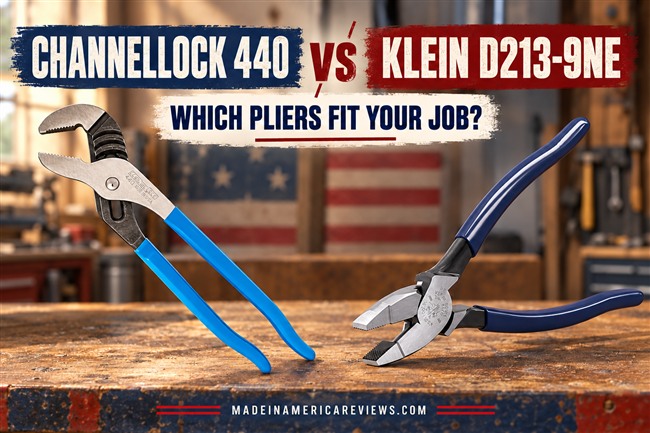
Put the Channellock 440 beside the Klein Tools D213-9NE and the first surprise is that this is not really a contest between two versions of the same tool. The Channellock is a 12-inch adjustable tongue-and-groove plier made to wrap around pipe, fittings and awkward hardware. The Klein is a 9-inch high-leverage lineman’s plier built to grip, twist and cut wire.
Both are forged in the United States. Both have earned 4.8-star owner averages across thousands of ratings. Both come from American tool companies whose names became shorthand on jobsites. But if you ask which one wins without first naming the job, you are asking the wrong question.
Here is the useful answer: the Channellock 440 is the better general-purpose choice for plumbing, fittings and a homeowner’s toolbox; the Klein D213-9NE is the better specialist for electrical and wire work. One grips changing diameters. The other turns leverage into cutting and twisting power. The winner is the one whose jaws match the work in front of you.
The scoreboard
Channellock 440
Made in USA
A 12-inch straight-jaw tongue-and-groove plier forged in Meadville, Pennsylvania. Its 2.25-inch jaw capacity and seven-position adjustment make it the more versatile tool around pipe, fittings and irregular hardware. Carbon steel needs basic rust care, and rare bad pairs should be warrantied rather than tolerated.
Klein Tools D213-9NE
Made in USA
A 9-inch New England-nose lineman’s plier with a high-leverage pivot and side-cutting knives. It is the more precise, task-specific choice for gripping, twisting and cutting copper wire. The dipped handles are comfortable, but they are not electrical insulation.
Side by side
| Channellock 440 | Klein D213-9NE | |
|---|---|---|
| Tool type | Tongue-and-groove pliers | Lineman’s pliers with side cutters |
| Primary job | Gripping pipe, fittings and irregular hardware | Gripping, twisting and cutting wire |
| Length | 12 inches | 9 inches |
| Jaw | Straight serrated jaw, adjustable to 2.25 inches | New England nose with cross-hatched gripping surface |
| Adjustment | Seven tongue-and-groove positions | Fixed hot-riveted joint |
| Cutting | No dedicated cutter | Induction-hardened side-cutting knives |
| Leverage | Long handles and adjustable jaw geometry | High-leverage pivot placed close to the cutting edge |
| Weight | About 1.64 pounds | 17.6 ounces |
| Steel | U.S. high-carbon steel | Induction-hardened American tool steel |
| Grip | Channellock Blue plastic-dipped handles | Dark-blue plastic-dipped handles |
| Electrical protection | Not insulated | Not insulated; do not use on live circuits |
| Made | Meadville, Pennsylvania | United States |
| Owner rating | 4.8 / 5 across roughly 4,000 ratings | 4.8 / 5 across roughly 2,900 ratings |
| Our score | 4.5 / 5 | 4.7 / 5 |
The jaws decide the winner
The Channellock’s seven-position joint is the reason it belongs in a general toolbox. Open it for a drain fitting, close it for a stubborn nut, or set the jaws around a rounded object that ordinary slip-joint pliers cannot hold. The long handles multiply hand force, while the angled teeth keep the tool pulling into the work instead of skating off it. For plumbing repairs, hose connections and the oversized hardware that appears in garages and utility rooms, this is exactly the geometry you want.
The Klein’s fixed joint looks less versatile because it is. That is not a flaw. Its job is to keep the nose aligned while the pivot puts your grip close to the cutting knives. The broad, cross-hatched jaws hold conductors for twisting and pulling; the hardened cutters handle copper and other wire without making you reach for a second tool. On repeated electrical work, that focus is an advantage. You get a shorter, lighter tool whose effort goes where electricians need it.
Try to trade their jobs and the limits appear immediately. The Channellock can grab a bundle or pinch something in a hurry, but it has no side cutter and its 12-inch body is clumsy in a crowded box. The Klein can turn a fastener or grip a small fitting, but its jaw opening is fixed and its flat nose cannot wrap a large pipe. Neither becomes the other just because both have blue handles.
Leverage: adjustable reach versus concentrated force
The 440 gets its leverage from length and reach. At 12 inches, it gives you room to lean on a stuck fitting without moving to a pipe wrench, and the jaw position lets you keep the handles in a usable range as the work changes size. That makes it forgiving. A homeowner does not have to predict every diameter that will appear over the next decade; one plier covers a wide band of them.
Klein concentrates leverage at the pivot. The company says the high-leverage design produces 46 percent more cutting and gripping power than its conventional plier design, and the physical reason is visible: the rivet sits close to the cutting edge. That matters when the work repeats all day. Less wasted squeeze means less fatigue, cleaner cuts and a tool that feels stronger than its nine-inch length suggests.
For a single stubborn fitting, the Channellock’s longer handles win. For a box full of conductors, the Klein’s shorter force path wins. Again, the better design is inseparable from the job.
What owners actually complain about
Channellock 440. The most common complaint is cosmetic: the rust-preventive finish can look smeared when a newly coated tool is packed before the coating fully settles. Owners who mention it usually say the plier still works normally. That is different from the small number of genuine defects we found — a joint that binds, a pivot that arrives too loose or teeth that flatten early. Those are warranty problems, not break-in. The steel is also carbon steel rather than stainless, so surface rust is possible when the tool is stored wet. Wipe it dry and give the joint an occasional drop of oil.
Klein D213-9NE. Most negative reports cluster around quality-control outliers: cutters that do not meet cleanly, an unusually stiff joint, edge chipping or grips that begin to creep. Rust can appear here too if the tool is put away wet. Klein’s dipped grips are comfortable but replaceable-wear items, and warranty claims go more smoothly when the tool came from an authorized seller and the receipt is still available. More important than any complaint: these are not insulated handles. A dark-blue dip is not permission to work a live circuit.
Which one should you buy?
Buy the Channellock 440 if this is the first serious plier going into a home, truck or general maintenance kit. It is the more adaptable tool, the better answer for plumbing and mechanical repairs, and the one most likely to solve a problem you did not plan for. Its extra length is useful when access is open and the hardware is stubborn. If you buy only one of these for nonspecialist household work, buy this one.
Buy the Klein D213-9NE if wire is the work rather than an occasional obstacle. Electricians, installers and anyone repeatedly cutting and twisting conductors will use its dedicated edges and fixed-jaw control every day. It is also the easier tool to carry and maneuver in boxes. Just match the tool to the safety requirement: the D213-9NE is not insulated and is not a substitute for a properly rated tool on energized circuits.
If your work crosses both lanes, buy both rather than forcing either one to impersonate the other. That is not an evasive verdict. It is the reason these two American-made designs have survived: the Channellock opens wide and holds irregular shapes; the Klein stays aligned and cuts. A toolbox with one of each has less overlap than a photograph suggests.
Shop the exact models
We verify manufacturing against primary sources, compare published exact-model evidence, and do not accept payment or free products for rankings. This is an independently researched comparison, not a hands-on test.
Read the full reviews
- Channellock 440 review: The Pliers That Became a Household Word
- Klein D213-9NE review: Read the Label, Not the Logo
Bottom line
The Channellock 440 wins on range: large adjustable jaws, long handles and the ability to deal with the plumbing and hardware surprises that make a general toolbox earn its keep. The Klein D213-9NE wins on focused control: a compact high-leverage joint, wire-ready jaws and real side cutters. For homeowners and plumbing work, choose Channellock. For electricians and wire work, choose Klein. For a complete American-made plier drawer, they belong side by side.