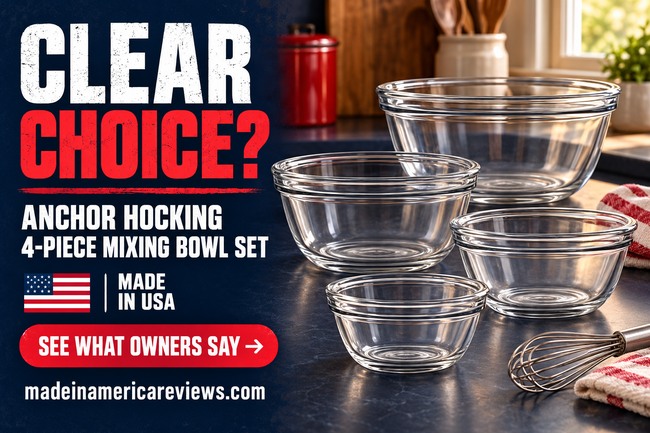
Anchor Hocking’s four-piece glass mixing bowl set covers the everyday prep range with 1-quart, 1.5-quart, 2.5-quart and 4-quart bowls. The exact 4 Piece Set selection showed 4.4 out of 5 from 3,043 customer reviews when checked October 19, 2026. Owners like the useful size spread, clear glass and easy cleanup. The harder question is whether the extra weight and breakage risk of tempered glass fit the way you cook and store bowls.
We verify manufacturing against primary exact-model evidence, analyze recurring owner feedback, and do not accept payment or free products for rankings. This is an independently researched review, not a hands-on test.
This review covers the four-bowl set selected on the current listing. It does not cover the 10-piece style, lidded food-storage sets, batter bowls or lookalike imported glass bowls. The retailer listing visibly combines feedback from more than one style on the parent listing, so owner themes are useful at the product-family level; the direct product selection, Store route and manufacturing check are specific to the four-piece set.
Four sizes make this a practical prep set
The capacity progression is sensible. The 1-quart bowl handles an egg wash, chopped garnish or a small sauce. The 1.5-quart size is useful for toppings and modest batches. The 2.5-quart bowl takes on batters, salads and side dishes, while the 4-quart bowl provides the room needed to fold ingredients without immediately pushing them over the rim.
Owner feedback repeatedly praises the range of sizes and the set’s versatility. The exact four-piece reviews that are visible on the current listing describe the bowls as sturdy and useful for reducing plastic in the kitchen. That is a better reason to buy this set than novelty: the capacities cover distinct jobs without filling a cabinet with tiny specialty bowls.
The bowls nest, but glass-on-glass storage needs more care than stacking stainless steel. A paper towel, thin cloth or felt separator between bowls can reduce rim contact and makes it easier to lift one bowl without clacking the others together. Do not force a bowl that has wedged into the one below it.
Clear glass is useful, heavy and unforgiving
Transparency is a real working advantage. You can see whether dry pockets remain at the bottom of a batter, check the level of a marinade and present a salad without transferring it to another dish. Glass also does not retain food color or odor the way some plastics can, and owners frequently describe the bowls as easy to clean.
The cost is weight. Owner feedback is mixed on this point: some buyers find the bowls manageable, while others call them heavy compared with steel or plastic. The 4-quart bowl becomes meaningfully heavier once it contains dough or batter. Anyone with limited grip strength should lift it with two dry hands and avoid carrying it by the rim.
Glass also makes damage binary. Stainless steel can dent and plastic can scratch; a compromised glass bowl should leave service. Inspect every rim and base on arrival, then check for chips, cracks or pronounced scratches before use. The current retailer detail page marks the listing as a frequently returned item, and broken-on-arrival reports recur in the combined owner pool. That shipping risk belongs in the buying decision even though many owners receive intact, durable sets.
Tempered glass is strong, not indestructible
Anchor Hocking identifies its U.S.-made bakeware as tempered soda-lime-silicate glass and includes mixing bowls in that bakeware category. Tempering strengthens the material and is designed to make breakage produce many generally smaller, less sharply edged pieces than ordinary non-tempered glass. It does not make the bowl immune to impact or rapid temperature change.
The manufacturer says impacts are the most frequent cause of failure. Hard contact with a sink, faucet, countertop edge or another bowl can create damage that is not obvious immediately. Abrasive scouring and sharp utensils can also compromise the surface. Silicone, wood and plastic tools are the safer companions when a metal utensil is not necessary.
Thermal shock is the other major limit. Do not add cool liquid to a hot bowl, put hot glass into dishwater, or place a hot bowl directly on a cold or wet counter. Use a dry pad or trivet and let the glass cool naturally. A bowl that survived a previous misuse has not necessarily escaped damage.
Oven capable does not mean heat-anywhere
The exact listing promotes microwave, oven and dishwasher use, and Anchor Hocking classifies the listed bowl sizes as bakeware. The manufacturer’s safety guidance is more important than the marketing shorthand: first check the marking on the bottom of each bowl to confirm microwave and oven suitability, and keep oven use at or below 425°F.
These bowls are not for a stovetop, broiler or toaster oven. They should not sit on a recently used or still-warm burner. Those restrictions rule out direct-flame tasks and make the bowls less flexible than metal for cooks who routinely move vessels between heat sources.
Microwave use is convenient for melting butter or reheating ingredients, but the glass and contents can become very hot. Use dry potholders. Dishwasher cleaning is straightforward; load the bowls so they cannot strike another hard item during the cycle. For stuck-on residue, soak rather than attacking the glass with an abrasive pad.
What owners actually report
The current listing showed 4.4 out of 5 from 3,043 customer reviews on October 19, 2026. The listing’s visible review summary identifies size options, value, versatility, appearance and cleaning as strong themes. Durability and weight are mixed, while quality complaints include bowls that arrived broken or fractured.
The size range earns the clearest praise. Buyers like having a small prep bowl, two middle sizes and a true mixing bowl in one set. The four-piece option is less exhaustive than the 10-piece style, but that restraint is useful in a normal kitchen where cabinet space matters.
Owners value glass as an alternative to plastic. Exact four-piece reviewers specifically mention sturdiness and reducing plastic at home. The transparent bowls also move easily from preparation to serving, and the dishwasher-safe design simplifies cleanup.
Breakage is the recurring risk. The combined listing includes reports of cracked, chipped or shattered bowls on delivery. Some complaints point to the retail box moving inside a larger shipping carton. That is partly a fulfillment problem rather than a judgment on normal service life, but it still affects the buyer who has to inspect and replace a set.
Weight divides buyers. Thick glass feels stable on a counter and communicates substance; it is also heavier than steel or plastic. The same characteristic can be either a strength or a burden depending on hand strength, cabinet height and whether the largest bowl is often carried while full.
Made in USA verification
- Exact listing: the current four-piece product selection identifies the set as Made in USA.
- Primary manufacturing statement: Anchor Hocking says its production is performed at its original Lancaster, Ohio, location.
- Exact component match: the manufacturer’s 2025 retail catalog lists the same four open-stock mixing bowl sizes: 1 qt. item 81573L20, 1.5 qt. item 81574L20, 2.5 qt. item 81575L20 and 4 qt. item 81629L20.
- Material: Anchor Hocking identifies its U.S.-manufactured bakeware as tempered soda-lime-silicate glass and expressly includes mixing bowls in that category.
- Scope: this verification applies to the four glass bowls in the reviewed set, not every product sold under the Anchor Hocking name.
We classify this exact four-piece bowl set as Made in USA. The verification combines the direct listing claim with the manufacturer’s Lancaster production statement and catalog-level confirmation of all four component sizes. It should not be generalized to unrelated Anchor Hocking products without their own evidence.
Specifications
| Product reviewed | Anchor Hocking 4 Piece Glass Mixing Bowls Set |
| Included capacities | 1 qt., 1.5 qt., 2.5 qt. and 4 qt. |
| Manufacturer component items | 81573L20, 81574L20, 81575L20 and 81629L20 |
| Material | Tempered soda-lime-silicate glass |
| Use | Mixing, prep, serving; microwave and oven use only when confirmed by bottom marking |
| Maximum oven temperature | 425°F under manufacturer care guidance |
| Not for | Stovetop, broiler, toaster oven or a warm burner |
| Cleaning | Dishwasher safe; avoid abrasive scouring and hard impacts |
| Origin | Made in Lancaster, Ohio, USA |
| Owner rating | 4.4 / 5 from 3,043 reviews, checked October 19, 2026 |
Glass or stainless steel?
| Anchor Hocking glass | Stainless steel bowls | |
|---|---|---|
| Visibility | See the mixture from every angle and serve in the same bowl | Contents are hidden from the side and bottom |
| Weight | Heavier, especially when the 4-qt. bowl is full | Usually much lighter for carrying and overhead storage |
| Impact tolerance | Can chip or break and must be retired when damaged | Can dent but normally will not shatter |
| Microwave use | Permitted when the bottom marking confirms suitability | Not microwave safe |
| Odor and stain resistance | Nonporous glass resists food odor and color | Stainless steel also resists odor and staining |
Pros & cons
Pros: The four capacities cover small prep through full-batch mixing without unnecessary duplicates; clear glass makes it easy to check texture and use the same bowl for serving; tempered construction is stronger than ordinary untreated glass; the set is microwave, oven and dishwasher capable when used according to its markings and care instructions; glass does not retain food odors or colors; owners repeatedly praise the size range, versatility, appearance, cleaning and value; exact four-piece feedback is positive about sturdiness; and the manufacturing evidence supports a clear Made in USA classification.
Cons: Glass is heavier than steel or plastic; the 4-quart bowl can be awkward when full; any chip, crack or deep scratch means the bowl should be retired; owner feedback includes recurring broken-on-arrival reports, and the retailer marks the listing as frequently returned; nested glass needs separators and careful handling; severe temperature changes can cause failure; the bowls cannot be used on a stovetop, under a broiler or in a toaster oven; the maximum oven temperature is 425°F; there are no lids in this set; and the listing’s 3,043-review total spans multiple style selections, so not every review describes the exact four-piece configuration.
Should you buy it?
Yes—if you want a compact, American-made glass prep set and will handle it like glass.
The Anchor Hocking four-piece set earns a recommendation because the capacity range is well judged, the clear bowls work for mixing and serving, and the domestic manufacturing evidence is unusually direct. The owner pool strongly supports usefulness and easy cleanup. The qualification matters: inspect the shipment immediately, separate the bowls in storage, avoid impacts and thermal shock, and respect the 425°F and no-stovetop limits. Choose stainless steel instead if low weight and drop tolerance matter more than microwave use and visibility.
Shop the Anchor Hocking 4-Piece Set at the Buy American Store