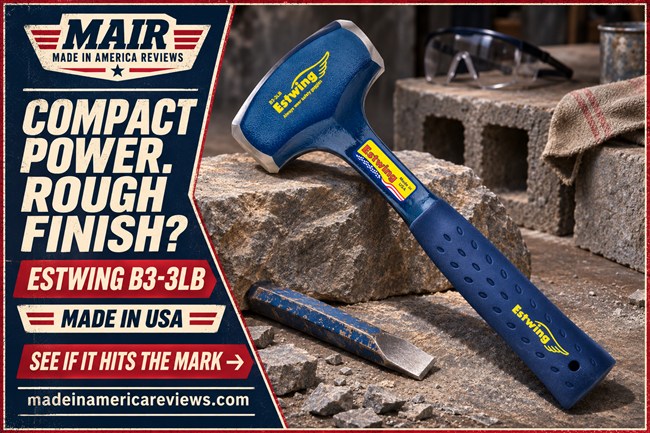
The Estwing B3-3LB is a short-handled, three-pound drilling hammer built to deliver a concentrated blow where a long sledge cannot swing. The exact routed listing showed 4.8 out of 5 from 1,322 reviews when checked November 20, 2026. Owners repeatedly praise its compact power, balance and one-piece durability. The tradeoff is specialization: three pounds is tiring for light tapping, the 11-inch handle gives up long-sledge leverage, and the blue finish may arrive looking more workmanlike than refined.
We verify manufacturing against exact-model evidence, analyze recurring owner feedback, and do not accept payment or free products for rankings. This is an independently researched review, not a hands-on tool test.
The exact Estwing hammer we reviewed
This review covers the Estwing B3-3LB Drilling Hammer: the blue, one-piece steel model with a three-pound head, two polished striking faces, an 11-inch overall length and Estwing’s molded Shock Reduction Grip. The owned Store route opens the exact B3-3LB listing and not a visually similar hammer.
That distinction matters because Estwing sells several three-pound tools with different construction and origin. The B3-3LB is the U.S.-made all-steel model. It is not the MRF3LB fiberglass-handle drilling hammer or the MRW3LB hickory-handle Sure Strike hammer, both of which Estwing identifies separately. Similar weight does not make those models interchangeable, and this score does not apply to them.
A drilling hammer is also different from an ordinary claw hammer. Its job is to strike chisels, punches, star drills and hardened nails with more authority than a standard hammer while remaining controllable in a cramped work area. Buyers who mainly drive framing nails or need demolition leverage should choose a tool designed for that work.
Three pounds in an 11-inch package
The B3-3LB’s defining idea is concentrated mass. A three-pound head carries significantly more momentum than a typical 16- or 20-ounce hammer, yet the short handle keeps the tool close to the hand. That combination helps when a wall, floor, machine or workbench leaves too little room for a long arc.
Owners often describe the weight as a useful middle ground between a standard hammer and a full-length sledge. The tool can deliver a decisive blow to a cold chisel or stubborn pin without demanding the overhead clearance of a longer hammer. The compact shape also makes it easier to start a strike squarely and to stop the swing before nearby material gets damaged.
The same weight can become a liability during repetitive light work. Three pounds at the end of even a short handle will fatigue the wrist and forearm faster than a lighter hammer. Buyers who mostly make small adjustments should consider the two-pound B3-2LB. Those breaking larger concrete sections or driving big wedges in open space may want the leverage of a long-handled sledge instead.
One-piece forging removes the usual weak joint
Estwing forges the head and handle from one piece of solid American steel. There is no wooden or fiberglass shaft seated into an eye and no separate head-to-handle connection to loosen. For a tool that repeatedly strikes steel accessories, that construction is a meaningful durability advantage.
The one-piece design does not make the hammer indestructible or excuse misuse. Striking faces can mushroom, chip or become unsafe if the wrong tool is hit, glancing blows are repeated or damaged accessories stay in service. It does, however, remove the failure mode that worries many owners of conventional hand sledges: a head working loose from the handle.
Long-term owner comments are unusually strong. Reviewers describe years or even decades of use, and current feedback repeatedly calls the tool solid, durable and built to last. Those reports are observations rather than laboratory proof, but they align with the simple construction and the high owner score.
The Shock Reduction Grip helps without changing the physics
Estwing bonds and molds its blue Shock Reduction Grip around the steel handle. The textured shape gives the hand a secure surface, while the resilient material is intended to reduce the vibration transmitted by impact. Owners frequently praise the grip and describe better comfort and control than a bare steel handle would provide.
The grip cannot erase every impact. A three-pound all-steel tool still sends force through the hand and arm, especially when the blow lands off-center or the struck tool is too hard, too small or poorly supported. The practical benefit is moderation, not isolation. Good technique, an appropriate hammer weight and a square strike still matter.
The molded grip also avoids the seam and movement of a slip-on sleeve, but it becomes the component most difficult to replace if badly cut or worn. Inspect the handle before use and retire the tool if the grip no longer provides secure control. A durable forging is useful only when the operator can hold it safely.
Two polished faces, with finish variation to expect
Both faces are polished, giving the user the same basic striking surface whichever end is presented. The blue UV coating protects the unpolished steel and makes the tool easy to recognize. The exact routed listing explicitly warns that finish may vary, and owner feedback supports taking that wording seriously.
Most owners focus on function, balance and durability rather than cosmetic perfection. A current four-star review, however, described dents and indentations in the head and an uneven-looking painted finish. Another owner referenced isolated complaints about face squareness and reported that the face on their own hammer measured square. The pattern suggests variable cosmetic refinement, not a demonstrated across-the-board defect.
A drilling hammer is expected to acquire marks quickly in normal service, so a flawless display finish has limited practical value. Still, the striking faces should be sound, even and appropriate for the work. Inspect a new tool before use. Cosmetic texture in the forged body is one thing; a damaged or questionable striking face is a reason to exchange it.
What 1,322 owners actually report
The exact routed listing displayed 4.8 out of 5 from 1,322 reviews on November 20, 2026, comfortably above our 100-review minimum. It matched model B3-3LB, the three-pound hammer style and active purchase controls. The page did not present the count as pooled across several unrelated models.
Durability leads the praise. The listing’s owner summary highlights quality and longevity, and multiple reviews point to the one-piece forging as the reason the tool feels dependable under repeated heavy use. Some owners describe long service lives, while others report hundreds of chisel strikes without visible face damage.
Weight and control are the next recurring strengths. Owners like the three-pound compromise and the short handle in confined spaces. Balance, secure grip and a feeling of controlled power appear repeatedly in the feedback.
Finish is the clearest caution. Complaints are uncommon relative to the overall rating, but they are specific enough to include. Buyers who expect perfectly smooth paint and cosmetically uniform forging may be disappointed. The most useful conclusion is to inspect the delivered tool rather than assume either perfection or failure from a few reports.
Use the right striking tool and wear eye protection
Estwing identifies drilling hammers for striking chisels, punches, star drills and hardened nails. Its safety guidance says the user and bystanders should wear eye protection. That matters because metal, masonry and hardened accessories can release chips or fragments even when the hammer itself remains intact.
The company also warns against striking one hammer or hardened striking tool with another. The hammer face should be larger than the face of the tool being struck, and the accessory must be designed to receive blows. Do not use the B3-3LB as an improvised anvil, pry bar or substitute for a soft-face hammer where surface protection is required.
Heavy blows in a small space can feel deceptively controlled. Clear the swing path, support the work, keep hands away from the strike zone and stop if the grip, face or struck tool shows damage. The compact handle reduces the room required; it does not reduce the consequences of a miss.
Made in USA verification is exact-model specific
- Exact official page: Estwing identifies model B3-3LB by item number, three-pound head and 11-inch overall length.
- Material and construction: the official page states solid American steel and one-piece forged head-and-handle construction.
- Origin: Estwing marks the exact drilling-hammer line Made in the U.S.A.
- Exact Store route: the owned Store button opens ASIN B00002N5NI with the B3-3LB identity and active purchase controls.
- Duplicate check: MAIR searches for B3-3LB and Estwing drilling hammer returned no existing review.
We classify the exact Estwing B3-3LB as Made in USA from solid American steel. Estwing also sells imported tools, including similarly weighted Sure Strike models, so this conclusion must not be generalized to every hammer carrying the Estwing name.
Specifications
| Product reviewed | Estwing Drilling Hammer B3-3LB |
| Head weight | 3 lb / 1.3 kg |
| Overall length | 11 in / 279 mm |
| Construction | Head and handle forged in one piece |
| Material | Solid American steel |
| Faces | Two fully polished striking faces |
| Finish | Blue UV coating; finish may vary |
| Grip | Bonded and molded blue Shock Reduction Grip |
| Intended uses | Chisels, punches, star drills and hardened nails |
| Manufacturing | Made in U.S.A., exact B3-3LB model |
| Owner rating | 4.8 / 5 from 1,322 reviews, checked November 20, 2026 |
B3-3LB, two-pound drilling hammer or long sledge?
| Estwing B3-3LB | Two-pound drilling hammer | Long-handled sledge | |
|---|---|---|---|
| Strike force | Strong for a compact tool | Moderate | Highest with room to swing |
| Tight-space control | Excellent | Excellent | Limited |
| Repetitive light work | More tiring | Easier to manage | Poor fit |
| Leverage | Short 11-inch handle | Short handle | Long handle |
| Best fit | Controlled heavy blows to chisels and punches | Lighter tapping and smaller accessories | Open-space demolition and large wedges |
Pros & cons
Pros: Exact-model Made in USA evidence is clear; solid American steel is documented; one-piece forging removes the separate head-to-handle joint; the three-pound head delivers substantial force; the 11-inch length works in confined spaces; two polished faces simplify orientation; the molded grip improves security and moderates vibration; owner feedback strongly supports balance and durability; 1,322 reviews provide a substantial signal; the exact Store route is current; the model identity is easy to distinguish; Estwing publishes dimensions and intended uses; the tool fits chisels, punches, star drills and hardened nails; and the 4.8 owner score is unusually strong.
Cons: Three pounds is tiring for repeated light tapping; the short handle cannot match the leverage of a long sledge; finish quality may look rough or uneven; paint and forging texture can vary; isolated owners have questioned face refinement; the all-steel body still transmits impact; the grip is not a substitute for correct technique; damaged molded grip material is not as easily replaced as a wood handle; the hammer is specialized rather than all-purpose; it must not be confused with imported fiberglass or hickory Estwing models; eye protection is essential; and buyers should inspect both faces before use.
Should you buy it?
Yes—if you need compact, controlled three-pound striking power and value one-piece U.S.-made construction.
The Estwing B3-3LB earns a 4.4/5 for its strong exact-model manufacturing evidence, excellent 1,322-owner signal, balanced short-handle format and durable one-piece forging. It is a particularly good fit for chisels, punches and stubborn work in confined spaces. Choose the two-pound model for frequent lighter taps, or a long-handled sledge when leverage matters more than close control. Inspect the delivered finish and striking faces before use.