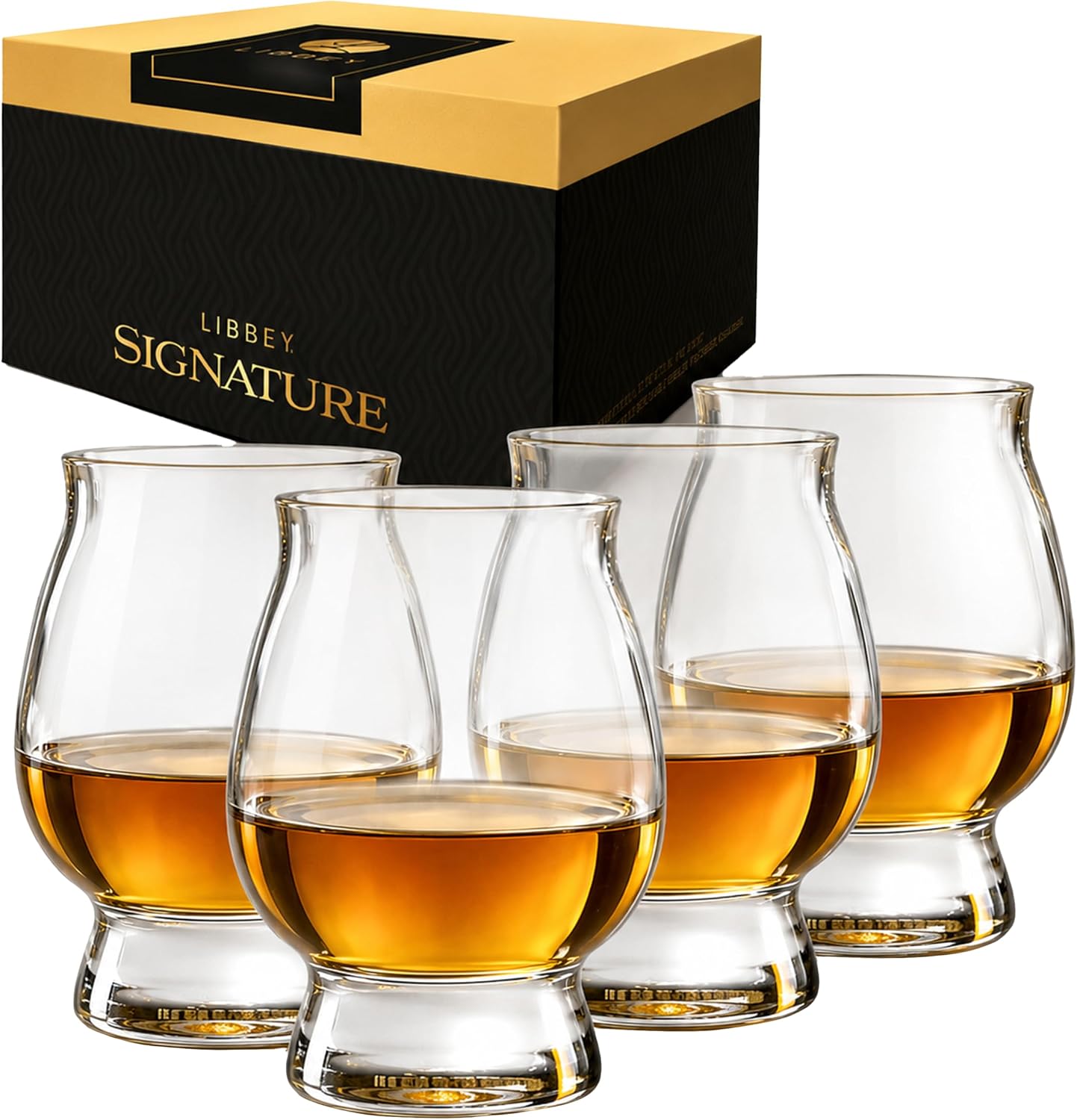
Kentucky does not hand out its name. The Kentucky Bourbon Trail is the Kentucky Distillers’ Association’s own program, and the association is not casual about who gets to put that logo on a product. So when a glass company gets the license, the interesting question is not whether the glass is good. It is which glass company Kentucky picked. It picked a 200-year-old Ohio glassworks whose pressed tumblers you have already drunk from in a hundred restaurants without once looking at the bottom. That is the story of this glass: the official tasting vessel of America’s native spirit is a piece of everyday American factory glass, made about four hours north of Bardstown, and it is priced like the workhorse it is rather than the souvenir it could have been.
We verify manufacturing against primary sources, read what actual owners report, and never accept payment for rankings.
Which one is this, exactly?
Libbey sells two Kentucky Bourbon Trail glasses and they are easy to confuse, because the packaging, the etching and the brand line are identical. This review covers the smaller one.
The glass here is Libbey item 9196/L006A, sold as the Signature Kentucky Bourbon Trail Whiskey Tasting Glasses, 8 ounce, set of 4. It is 3 inches across and 3.8 inches tall — a tulip bowl sitting on a thick sham, which is glassmaker’s language for a heavy solid base rather than a drawn stem. Libbey’s own copy calls it a thick stem; in the hand it reads as a short, weighted foot. The Kentucky Bourbon Trail logo is laser etched into the bottom of the bowl.
The other one is item 1009289/L006A, the Kentucky Bourbon Trail Whiskey Cocktail glass, 13.5 ounce, set of 4. Same etching, same family, much bigger bowl, and a different job — that is the one to buy if you want to build an Old Fashioned in it. It also carries a far shallower owner record, with 60 ratings against this glass’s 1,882, which is why we are reviewing the tasting glass and not the cocktail glass.
If you are shopping from a listing that says only “Bourbon Trail glasses,” check the ounce figure and the item number before you buy. The two products photograph almost identically and the wrong one will disappoint you in opposite directions.
What it is like to drink from
The design intent is narrow and it is met. A tulip bowl with a rim narrower than its widest point collects the volatiles coming off a spirit and funnels them toward your nose instead of letting them dissipate over an open rocks glass. That is the entire point of a nosing glass, and it works here the way it works on a Glencairn: pour two fingers of a barrel-proof bourbon into a rocks glass and then into this, and the difference is not subtle.
Where it departs from the Glencairn is the rim. This glass is deliberately wider at the mouth — roughly two and a fifth inches by one owner’s measurement — and that single decision drives most of what people like and dislike about it. Wider means the ethanol comes at you less violently on a high-proof pour, which several owners specifically call out as the reason they prefer it to a Glencairn for cask-strength whiskey. Wider also means a large ice cube or a two-inch sphere actually fits, which a Glencairn will not do. And wider means it is harder to swirl aggressively without wearing your bourbon, which one owner warns about in plain terms.
The base is the other thing people notice. It has real mass, which does two things: it keeps the glass from tipping when it is nearly empty, and it gives the glass a heft that reads as more expensive than it is. Owners who have handled thin borosilicate tasting glasses tend to say they prefer this. Owners who wanted delicate stemware do not.
The rim itself is thin and laser cut — no rolled bead, no ridge for your lip to find. That is the correct choice for a tasting glass and it is also, as we will get to, the part of this glass that owners report arriving damaged.
The eight-ounce problem
This is the most common complaint in the pool and it is worth understanding precisely, because it is half a real defect and half a misunderstanding of how glassware is specified.
Libbey specifies this glass at 8 ounces. That is brim capacity — the volume of liquid the glass physically contains when filled to the absolute lip, which is how the glassware industry has always stated capacity and how every glass in Libbey’s catalogue is measured. It is not a serving size. Nobody fills a nosing glass to the rim; doing so defeats the tulip shape entirely, because the whole mechanism depends on headspace above the liquid.
Owners still hit it. One measures about 7 ounces filled to the top. Another measures about 6 and says flatly that the description should be changed. A third reports exactly 8 to the rim. That spread is wider than manufacturing tolerance should allow and suggests owners are measuring to different definitions of “full,” but the direction of the complaint is consistent: people expect an eight-ounce glass to serve something close to eight ounces, and this one serves a proper tasting pour of an ounce and a half to three ounces with room to breathe.
The practical consequence: two owners describe the glass as “tiny,” and one who expected a snifter says what arrived is closer to what he would call a cordial glass. He also concedes the listing was accurate and he did not read it. Both things are true. The spec is technically correct and the expectation it sets is wrong, and Libbey could fix that with one sentence of copy.
What owners actually say
The pool is deep — 1,882 ratings at 4.7 stars, with 84 percent at five stars and 11 percent at four. That is a large, mature sample, not a thin one, so the complaints inside it are worth reading carefully rather than dismissing as noise.
The one genuine defect is cosmetic flaws on arrival, and it is documented. One buyer ordered a set as a gift, found a visible scratch or small crack in every one of the four glasses, exchanged the whole set, and got a second set with the same problem. Another reports one glass arriving chipped. A third describes the rim as very fragile and warns against the dishwasher despite the dishwasher-safe rating. A fourth — a five-star reviewer — volunteers that he was relieved not to hit “any of the issues a few others have had with broken glasses or uneven glass rims,” which tells you the problem is known inside the community of buyers.
Treat that as a defect, not a quirk. Pressed glass with a laser-cut rim can carry seed lines, stones and rim chips out of the factory, and a tasting glass is the worst possible place for them because you are literally holding the glass up to a light and studying the liquid. Open the box, run a fingertip around each rim, and hold each glass to a window before you gift it or put it in a cabinet. If a glass is flawed, return it. At roughly two percent one-star ratings the rate is low, but it is not zero, and the one buyer who got two bad sets in a row shows it can cluster.
The second complaint is the etching. The Kentucky Bourbon Trail logo is laser etched into the base and it is subtle to the point of invisibility — one owner says you have to hold an empty glass up to a bright light to see it at all, and calls paying anything extra for it a farce. He is right about the visibility. Whether that matters depends on whether you are buying a licensed collectible or a working glass.
The third is that it is not a Glencairn and some people want a Glencairn. One owner finds it mutes the bourbon compared to his Glencairn and has parked the set on the bar. Another prefers a competitor’s neat glass as easier to swirl and a couple of ounces larger. These are preference reports rather than fault reports, and the same wide rim gets praised by roughly as many owners for the opposite reason.
The praise is specific rather than generic, which is the useful kind. Reviewers cite the feel in the hand and the weighted bottom, the thin lip, the ability to fit a large ice cube, and the reduced nose burn on high-proof pours. Several are repeat buyers ordering a second set. One notes they stack. The most common single theme across the pool is build quality, followed by appearance and size — and the size theme cuts both ways depending on what the buyer expected.
What is not in the pool is telling too: no reports of the glass shattering in normal use, no reports of the etching wearing off, and no pattern of dishwasher failure beyond the one rim-fragility warning. For a pressed soda-lime glass sold as an everyday item, that is a clean record.
Made in USA Verification
- Libbey states the origin of this specific item, on its own store, in its own words: “Proudly made in the USA” in the opening line of the product description, and again in the feature list as “Made in the USA from durable, lead-free glass.”
- There is a per-item country-of-origin field, and it says United States. At the foot of the same page Libbey publishes “Product Dimensions (Country of Origin): Whiskey Glass — 3.0 x 3.0 x 3.8 inches (United States).” That is a structured origin declaration attached to this SKU, not a slogan.
- The claim is unqualified. No “with globally sourced components,” no “assembled in,” no “of domestic and imported materials.” Libbey says made in the USA and stops. We tier it exactly as written: Made in USA.
- The designation is selective, which is what makes it credible. Libbey’s retail store maintains a curated Made In the USA collection, and this glass is in it. That collection holds 123 products out of roughly 258 in the retail catalogue — under half. A brand that tagged everything would be telling you nothing. A brand that tags 123 of 258 is making a per-item decision, and it has decided this one.
- The plant is real and it is named. Libbey’s corporate site lists the Toledo Plant at 940 Ash Street, Toledo, Ohio, alongside its headquarters at 300 Madison Avenue in the same city. Libbey has made glass in Toledo since 1888.
- What we did not accept. Libbey is a multinational. Its own locations page lists operations in Monterrey, Mexico (the Crisa subsidiary) and Langfang, China, and its corporate story page notes a design studio in Monterrey. The Libbey name on a box is therefore not by itself an American-made signal, and we did not treat it as one. We also did not carry over the second American plant our own brand guide mentions: Libbey closed its Shreveport, Louisiana works at the end of 2020 after 98 years, and demolition of the site began in 2026. Toledo is the U.S. glass plant today.
- A rejected sibling, for calibration. Libbey’s Blue Ribbon rocks glasses clear our owner-review threshold comfortably but are not in the Made In the USA collection. We did not review them. The tag is the gate, and it has to be able to say no.
Specifications
| Item number | 9196/L006A |
| Line | Libbey Signature — Kentucky Bourbon Trail |
| Type | Whiskey tasting glass — tulip bowl, thick sham base |
| Set size | 4 |
| Capacity | 8 oz brim capacity (a tasting pour uses a fraction of it) |
| Dimensions | 3.0″ x 3.0″ x 3.8″ |
| Material | Pressed soda-lime glass, lead free and BPA free |
| Rim | Laser cut, no rolled bead |
| Decoration | Official Kentucky Bourbon Trail logo, laser etched into the base |
| Packaging | Gift box |
| Care | Dishwasher safe per Libbey; several owners hand wash because of the thin rim |
| Manufacturing | Toledo Plant — 940 Ash Street, Toledo, Ohio |
| Origin | “Proudly made in the USA”; per-item country of origin published as “(United States)” (Libbey) |
| Company founded | 1818, as the New England Glass Company; moved to Toledo in 1888 |
| Owner rating | 4.7 out of 5 — 1,882 ratings (84% five-star, 11% four-star, 2% three-star, 1% two-star, 2% one-star) |
How it compares
The reference point for every nosing glass is the Glencairn, which is made in Scotland and is the shape the whisky industry standardised on. Against it, this Libbey trades precision for approachability. The Glencairn’s narrow chimney concentrates aroma harder and is easier to swirl; this glass’s wider mouth softens the ethanol on a high-proof pour, takes a large ice cube, and is more comfortable to actually drink from rather than merely nose from. Owners who have both tend to keep both, and the ones who describe a clear preference split roughly along whether they drink cask-strength or standard-proof.
Inside Libbey’s own catalogue, the honest comparison is against the 13.5-ounce Bourbon Trail Cocktail glass in the same family. That one is a mixing and sipping glass. This one is a tasting glass. Buying the wrong one is the single most likely mistake with this product, and no amount of review reading fixes it — you have to check the ounce figure.
Against Libbey’s general rocks glasses — the Gibraltar, Charleston and Aspen lines you will recognise from restaurants — this is a different category rather than a better one. A rocks glass is for a built drink. This is for a neat pour you intend to pay attention to. If you are buying one set of glasses to do both jobs, buy the rocks glass; it will do the tasting job badly, and this glass will do the cocktail job worse.
Related guide
Buying Guide
The Best American-Made Glassware & Dinnerware
Four verified choices for tasting, everyday drinkware, baking, and the dinner table.
Related reviews
Pros & Cons
Pros: An unqualified, per-item Made in the USA statement from Libbey on its own store, backed by a structured country-of-origin field reading “(United States)” — a stronger and more specific claim than most glassware brands will make; membership in a curated domestic collection that covers under half the catalogue, so the designation carries real information; a named plant in a city that has made glass since 1888 and a company that traces to 1818; a tulip bowl that does the aroma-concentrating job it is sold to do; a wider rim than a Glencairn that softens the ethanol burn on barrel-proof pours and takes a large ice cube, which owners repeatedly single out as the reason they prefer it; a heavy sham base that will not tip and feels far better than the price suggests; a thin laser-cut rim with nothing between your lip and the whiskey; lead free and BPA free; the glasses stack; they arrive in a gift box; the official Kentucky Bourbon Trail licence, which no other glass in this shape carries; and an owner pool of 1,882 ratings, which is deep enough that the absence of structural failure reports means something.
Cons: Cosmetic flaws on arrival are a real and documented failure — scratches, small cracks and chipped or uneven rims, with one buyer receiving two defective sets in a row — so this is a product you inspect before you gift it; the 8-ounce figure is brim capacity and reads as an eight-ounce serving, which is the single most common complaint in the pool and leaves several owners calling the glass tiny or closer to a cordial than a snifter; the laser etching that justifies the licensing is nearly invisible unless you hold an empty glass to a bright light; the thin rim makes owners nervous about the dishwasher despite the dishwasher-safe rating; the wide mouth that helps with nosing makes vigorous swirling a spill risk; at least one owner finds it mutes a bourbon relative to a Glencairn; it costs meaningfully more than a plain Libbey rocks glass of the same material from the same plant, and most of that gap is the licence and the box rather than the glass; and Libbey’s corporate name is not an origin signal on its own, so this verification does not transfer to the next Libbey product you pick up.
Should You Buy It?
Yes — with one caveat.
Buy it if you drink bourbon neat or over a single large cube and you want a proper nosing glass that is comfortable to hold, easy to replace and made in Ohio rather than shipped in. The origin evidence here is unusually good for glassware: an unqualified statement on Libbey’s own store, a structured country-of-origin field naming the United States, and a curated domestic collection that excludes more than half the catalogue — including a Libbey rocks glass we would otherwise have liked. Do not buy it expecting an eight-ounce pour; that number is brim capacity and this is a tasting glass, and if you want to build a drink in it you want the 13.5-ounce Cocktail glass in the same family instead. And do open the box and check every rim against a light before it goes in a cabinet or a gift bag — cosmetic flaws are the one failure this pool documents clearly, and the fix is a return rather than a shrug.
The exact model we reviewed — the Libbey Signature Kentucky Bourbon Trail Whiskey Tasting Glasses, 8 ounce, set of 4, item 9196/L006A — is stocked at the Buy American Store.
Buy the Libbey Bourbon Trail Tasting Glasses at the Buy American Store
The 8-ounce tasting glass, item 9196/L006A. The 13.5-ounce Bourbon Trail Cocktail glass is a different product in the same family and will not nose the same way.
Two Hundred Years in the Glass City
How a Massachusetts glassworks founded in 1818 became Toledo’s defining industry — what Libbey still makes in Ohio, which of its lines carry a domestic origin tag, and where the company’s Mexican and Chinese operations sit.