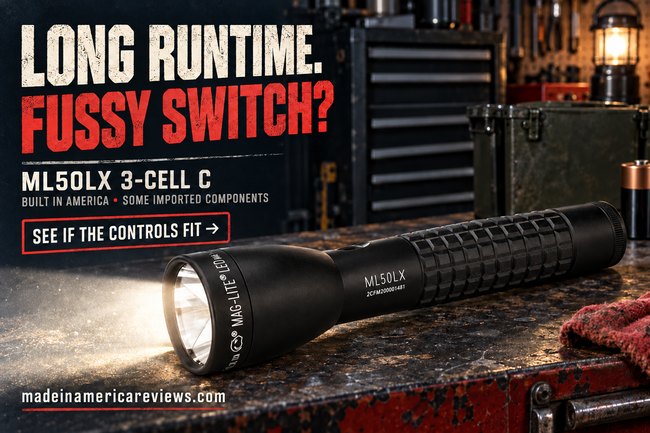
The Maglite ML50LX 3-Cell C LED is the middleweight answer for buyers who still want a substantial metal flashlight without carrying a full-size D-cell baton. The current exact model combines a long adjustable beam, three ordinary C batteries, an aggressive knurled grip and four selectable function sets. Its central tradeoff is not brightness. It is whether the electronic QuickClik control makes a dependable flashlight more useful or needlessly complicated.
We verify manufacturing against primary and exact-product evidence, analyze recurring owner feedback, and do not accept payment or free products for rankings. This is an independently researched review, not a hands-on beam or runtime test.
This review is limited to the Maglite ML50LX 3-Cell C LED in the selected 3-cell, matte-black configuration. The 2-cell ML50LX, the smoother-bodied ML50L and the larger ML300L/ML300LX lines are different products with different output, runtime, weight and controls. The exact Store route leads to the reviewed 3-cell ML50LX listing rather than one of those near-name alternatives.
A C-cell flashlight with a specific job
Modern rechargeable lights can produce more output from a much smaller body, but the ML50LX is built around a different priority. Three replaceable C cells are widely available, easy to store separately and do not require a proprietary charging cradle. The flashlight is 10.154 inches long and weighs 16 ounces with batteries, according to Maglite. That is large enough to find easily in a vehicle or emergency cabinet, yet less cumbersome than a multi-D-cell model.
Maglite currently rates the 3-cell version at 705 lumens on high, 105 lumens on low and 22 lumens in Eco mode. The beam is focused by turning the head through roughly one-quarter turn, changing quickly from spot to flood. Maximum published beam distance is 357 meters, with 31,889 candela peak intensity. These are manufacturer test figures, not our own measurements, but they establish the design intent clearly: reach and runtime matter more here than pocketability.
The deep crosshatch grip is one of the ML50LX’s best physical choices. Positive owners repeatedly mention the secure feel, manageable balance and fast focus adjustment. The matte finish also reduces the glossy, slippery feel of older smooth-bodied flashlights. At the same time, this is not a light for a pants pocket. Its natural homes are a garage, workshop, vehicle, utility closet or larger gear bag.
QuickClik adds flexibility—and the main learning curve
The electronic switch supports four function sets. General cycles through full power, low and Eco. Outdoor replaces Eco with strobe. Law Enforcement combines momentary, full power and Eco, while Tactical combines momentary, full power and strobe. The idea is sensible: buyers can move less-used functions out of the sequence instead of clicking through every possibility.
The catch is that the common sets begin at full power. Owners who want to preserve night vision or start discreetly in Eco cannot simply make the light default to its lowest level. They must remember the click sequence and move past high first. That is a small inconvenience in a workshop; it is more significant when checking a dark room, campsite or sleeping household.
Critical owner feedback also concentrates around the electronic switch rather than the aluminum body. Some buyers describe intermittent shutoffs or a light that will no longer restart once batteries have discharged past a certain point, even though the cells can still power simpler devices. A few report early switch failure followed by warranty service. These complaints are a minority in a strong owner record, but they identify the component most likely to undercut the product’s emergency-readiness appeal.
Runtime is excellent, but the headline needs context
Maglite publishes runtimes of 9 hours 45 minutes on high, 43 hours on low and 184 hours in Eco. The Eco figure is genuinely useful for prolonged outages or low-level navigation. It does not mean the light holds its initial brightness unchanged for that entire span; flashlight runtime standards measure to a defined fraction of initial output. Buyers should expect output to step down as batteries discharge.
The electronic cutoff behavior reported by some owners creates a second caveat. A light may have significant theoretical energy remaining while still refusing to restart below the switch circuit’s usable threshold. We cannot establish how common that behavior is from published feedback, and many owners report years of reliable service. The safer conclusion is that the ML50LX has impressive rated endurance but should not be the only light in a serious emergency kit.
The three-C format also has an operating-cost tradeoff. Standard cells are convenient, but heavy users may prefer a rechargeable system rather than repeatedly buying alkalines. Maglite lists this exact product as non-rechargeable and does not include batteries. Do not improvise lithium-ion cells or adapters that are not specifically approved for the model.
What 270 exact-listing owners report
The exact selected listing showed 4.6 out of 5 from 270 global ratings when checked October 9, 2026. The distribution was 80% five-star, 12% four-star, 4% three-star, 2% two-star and 2% one-star. That comfortably clears our 100-owner publication threshold, while remaining small enough that recurring failure reports deserve attention rather than being lost in a massive pool.
Beam reach and familiar construction are the recurring strengths. Satisfied owners describe a bright, clean beam that focuses quickly and reaches across yards and open property. The aluminum body feels more substantial than a lightweight plastic household flashlight, and the knurled section is easier to hold securely with damp or gloved hands.
The size is a productive compromise for many buyers. Owners who find D-cell lights bulky like the slimmer C-cell barrel. Several use it for vehicle checks, security work, walking dogs at night or general emergency duty. The light is still large by current rechargeable-flashlight standards, but that size makes it easy to grip and difficult to misplace.
The switch interface divides opinion. Some buyers appreciate the configurable sets and momentary mode. Others dislike having to pass through high output to reach Eco, find the low and high levels insufficiently separated, or consider the soft electronic button less reassuring than the older mechanical feel. The controls are learnable, but not instantly obvious to every owner.
Intermittent electrical failures are the meaningful defect pattern. A minority of verified buyers report early shutoffs, failure to turn back on with partially discharged batteries, or switch repairs. Separate complaints involve a stubborn tail cap and receiving the wrong color or the smoother ML50L instead of the ML50LX. Inspect the model marking, grip texture and selected color as soon as the package arrives.
Made in USA verification
- Exact model: Maglite identifies the product as the ML50LX 3-Cell C LED Flashlight.
- Current manufacturer statement: the exact product page says Maglite flashlights are invented, designed and engineered in America, then assembled and shipped from the company’s American factory.
- Domestic work: Maglite says all body parts and most other parts are made at its Southern California factory.
- Required qualifier: the company explicitly says some parts, components and accessories may be sourced overseas and directs buyers to package labeling for foreign content.
- Tier: qualified U.S. manufacture — built in America with some imported components.
This evidence is stronger than a headquarters claim or a vague “designed in USA” statement. Maglite describes machining and assembly work performed at its Ontario, California facility. It also prevents us from calling the flashlight wholly domestic. The accurate public wording is that the ML50LX is built in America with some imported components, not that every part is U.S.-made.
Specifications
| Product reviewed | Maglite ML50LX 3-Cell C LED Flashlight |
| Selected configuration | 3-cell, matte black |
| Maximum output | 705 lumens |
| Low / Eco output | 105 / 22 lumens |
| Beam distance | 357 meters |
| Peak beam intensity | 31,889 candela |
| Runtime | 9 hr 45 min high; 43 hr low; 184 hr Eco |
| Power | Three C-cell alkaline batteries; not included |
| Length | 10.154 inches |
| Weight | 16 ounces with batteries |
| Resistance | Water resistant; 1-meter drop resistance |
| Origin | Built and assembled in Ontario, California, with some imported components |
| Owner rating | 4.6 / 5 from 270 exact-listing ratings, checked October 9, 2026 |
ML50LX 3-Cell or a compact rechargeable?
| ML50LX 3-Cell C | Compact rechargeable | |
|---|---|---|
| Power source | Widely available replaceable C cells | Built-in or proprietary rechargeable cell |
| Emergency storage | Can be stored without batteries installed | Requires periodic charging |
| Size and weight | 10.154 inches; 16 ounces loaded | Usually much smaller and lighter |
| Peak output | 705 lumens | Often higher for the size |
| Controls | Four configurable QuickClik sets | Varies; many provide direct low access |
| Serviceability | Established maker and replaceable primary batteries | Battery replacement may be difficult |
Who should not buy it?
Skip the ML50LX if you need a pocket light, USB charging, direct access to moonlight/Eco mode or the highest possible output per ounce. Smaller rechargeable flashlights outperform it on compactness and peak brightness, and many provide simpler shortcuts to low and turbo modes.
It is also a questionable sole emergency light for anyone unwilling to maintain alkaline batteries and test the switch periodically. The body is rugged, but owner reports make clear that the electronic control deserves more attention than an old mechanical Maglite. A backup light remains sensible.
Pros & cons
Pros: Long published runtime; a beam rated to 357 meters; quick spot-to-flood focus; secure knurled grip; manageable size compared with D-cell models; ordinary replaceable batteries; four selectable function sets; sturdy anodized aluminum body; strong 4.6/5 exact-listing average; current availability; and meaningful U.S. machining and assembly backed by detailed manufacturer language.
Cons: No direct low-start mode in the common function sets; the electronic switch adds complexity; a minority of owners report intermittent shutoffs or early control failure; battery leakage requires disciplined storage; the flashlight is large beside current rechargeable competitors; C-cell operating cost can add up; some retail modules still show older output/runtime figures; and the qualified origin claim includes some imported parts and components.
Should you buy it?
Yes—if replaceable batteries, beam reach and a substantial grip matter more than pocket size.
The ML50LX 3-Cell C is a capable American-built general-duty flashlight with excellent rated endurance and a form factor that sits between compact rechargeables and oversized D-cell lights. Its aluminum construction and focus system are convincing; the QuickClik switch is the compromise. Buyers who understand the click sequences, maintain their batteries and keep a backup light are the best match.