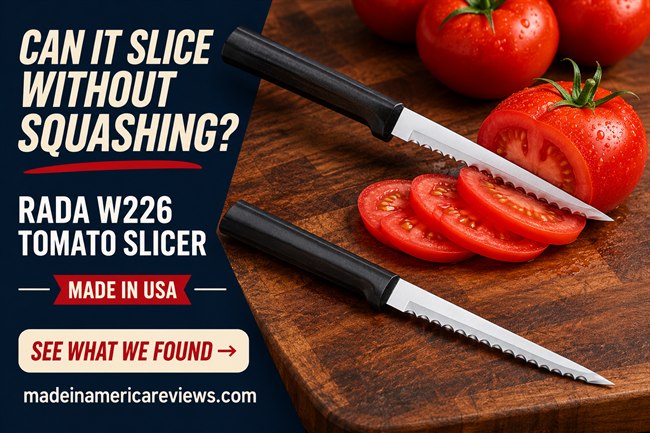
The Rada W226 Tomato Slicer is a lightweight, five-inch dual-serrated knife designed to get through tomato skin without forcing the soft flesh underneath. This review covers the exact black-handle W226 two-pack. The routed listing showed 4.8 out of 5 from 12,609 ratings when checked November 27, 2026. That large owner signal is strongly positive, but it is pooled across the listing’s color and pack-size variants rather than isolated to this two-pack.
We verify manufacturing against exact-model evidence, analyze recurring owner feedback, and do not accept payment or free products for rankings. This is an independently researched review, not a hands-on knife test.
The exact Rada knife we reviewed
This review covers the Rada Cutlery W226 Tomato Slicer with a black molded-resin handle, sold through the owned Store route as a two-knife pack. Rada identifies W226 as the black-handle version with a five-inch blade and an overall length of 8 7/8 inches. The routed purchase page opened the black, two-count selection rather than a single knife or a different handle.
That distinction matters because Rada sells the same basic blade in several handle families. The R126 uses the familiar silver aluminum handle, while the W426 Anthem version uses a larger black handle with a different shape. The blade concept may be similar, but care, grip feel and exact model identity differ. Our score applies to the W226 black-handle model and does not automatically transfer to every Rada tomato knife.
Why dual serrations suit tomatoes
A tomato is awkward for a plain edge because its skin resists the first cut while the flesh underneath collapses easily. The W226 approaches that problem with serrations on both sides of a thin five-inch blade. The teeth begin the cut with less downward pressure, while the narrow blade can continue through the tomato without pushing a wide wedge of steel between the slices.
The practical advantage is control. A light sawing motion should let the edge do the work instead of asking the user to press hard enough to bruise or squash the food. Serrations on both sides also make the slicing action usable from either hand, an often-mentioned benefit among owners.
This design does not make the knife a universal kitchen tool. The blade is intentionally slim, and the tip is sharp. It is not built for prying, twisting through joints, chopping bones or replacing a broad chef’s knife on a cutting board. Its value comes from doing a narrow group of delicate slicing jobs efficiently.
More useful than the product name suggests
Owners regularly use the W226 beyond tomatoes. Peppers, cucumbers, peaches, citrus, small breads and sandwich rolls all present some version of the same challenge: a tougher exterior surrounding a softer center. The five-inch length is enough for many of those foods without becoming cumbersome for a quick lunch or garnish.
The pointed tip can help start a cut or trim a small area, but it also deserves respect. Several owner comments emphasize how sharp the knife and point feel when new. Store it where the teeth cannot snag a hand, and avoid leaving it loose in a crowded drawer.
The two-pack makes practical sense for households that reach for this profile often. It can keep one knife available while the other is being washed, or place one at a second food-prep station. Buyers who only occasionally slice a tomato may prefer a single exact-model option rather than adding an unnecessary duplicate.
The black resin handle changes the care equation
The W226 uses a molded black resin handle rather than the silver aluminum handle found on Rada’s R126. The resin tolerates moisture and dishwasher exposure better than aluminum, which can discolor in automatic dishwashing. Even so, Rada recommends hand washing its knives to preserve appearance and edge life.
The handle is compact and light, matching the knife’s nimble purpose. Owners often praise the low weight and easy control. The tradeoff is that buyers who prefer a substantial, contoured or heavily textured handle may find it less filling in the hand than a larger modern design such as the W426 Anthem version.
What 12,609 owners actually report
The routed listing displayed 4.8 out of 5 from 12,609 ratings on November 27, 2026. The distribution shown was 91% five-star, 6% four-star, 2% three-star, 0% two-star and 1% one-star. That comfortably clears our 100-review minimum and provides an unusually large signal.
Sharpness and clean slicing lead the praise. Owners repeatedly describe thin tomato slices with less crushing and say the serrated edge stays useful for a long time. Lightweight handling, right- or left-handed use and versatility with bread, fruit and vegetables are other recurring positives.
Long service reports strengthen the durability case. Some reviewers describe using earlier Rada tomato slicers for years before buying replacements or extras. Those reports are observations, not controlled wear tests, but their consistency fits the simple stamped-blade construction and Rada’s long-running production of the model.
The main cautions are predictable. The point and teeth feel very sharp, the light handle will not satisfy everyone, and a serrated edge is less straightforward to restore at home than a plain blade. The count is also pooled across color and pack-size choices on the listing, so it should not be represented as 12,609 reviews of this exact two-pack alone.
Serrated-edge maintenance is different
Routine care should focus on protecting the teeth: hand wash, dry promptly, use a cutting board that is kind to edges and store the knife so it does not strike other metal. Do not drag the blade through a standard V-shaped pull-through sharpener. That tool is generally made for straight edges and can round or distort serrations.
When cutting performance eventually declines, a professional familiar with serrated knives or Rada’s service guidance is the safer route. Rada’s Quick Edge sharpener is marketed for non-serrated knives, so it should not be assumed appropriate for this blade. The company’s limited lifetime guarantee covers defects in material or workmanship; it is not a promise against normal wear, misuse or ordinary dulling.
Made in USA verification is exact-model specific
- Exact official page: Rada identifies model W226 by its black handle, 5-inch blade and 8 7/8-inch overall length.
- Material and construction: the exact page specifies T420 high-carbon stainless steel, a dual-serrated edge and a molded resin handle.
- Origin: Rada’s current exact-product claim says the knife and its materials are made in the USA.
- Exact Store route: the owned Store button opens the W226 black, two-count selection with active purchase controls.
- Duplicate check: MAIR searches found no existing W226 review. The existing Rada R101 article covers a different paring knife.
We classify the exact Rada W226 as Made in USA. Rada publishes unusually specific evidence for this model, but the conclusion remains exact-model specific and should not be generalized to an unverified knife merely because it carries the same brand.
Specifications
| Product reviewed | Rada Cutlery Tomato Slicer W226, black handle, two-pack |
| Blade length | 5 in |
| Overall length | 8 7/8 in |
| Blade material | T420 high-carbon stainless steel |
| Edge | Dual serrations |
| Handle | Black molded resin |
| Primary uses | Tomatoes and other soft-interior foods with firm skins or crusts |
| Care | Hand wash recommended; dry promptly |
| Manufacturing | Made in USA, exact W226 model |
| Owner rating | 4.8 / 5 from 12,609 pooled listing ratings, checked November 27, 2026 |
W226, R126 or W426 Anthem?
| W226 black | R126 silver | W426 Anthem | |
|---|---|---|---|
| Blade concept | 5 in dual-serrated | 5 in dual-serrated | 5 in dual-serrated |
| Handle | Compact black resin | Traditional silver aluminum | Larger contoured black handle |
| Dishwasher tolerance | Better than aluminum, though hand wash is preferred | Aluminum can discolor | Better than aluminum, though hand wash is preferred |
| Classic Rada feel | Light and simple | Most traditional | More modern and substantial |
| Best fit | Easy-care black handle and very low weight | Buyers who want the classic aluminum handle | Larger hands or preference for a fuller grip |
Pros & cons
Pros: Exact-model USA evidence is unusually clear; the dual-serrated edge suits tomatoes and other delicate foods; both-handed slicing is practical; the thin five-inch blade needs less downward pressure; the knife is lightweight and easy to control; black resin is more dishwasher tolerant than aluminum; hand washing is simple; the two-pack keeps a spare available; uses extend to peppers, fruit, cucumbers and small breads; 12,609 ratings provide a very large owner signal; the 4.8 average is excellent; long-use reports are common; the exact Store route is active; model W226 is easy to distinguish; Rada publishes dimensions and steel type; and the limited lifetime defect warranty is documented.
Cons: The pooled rating is not isolated to the black two-pack; the slim blade is not for chopping, prying or bones; the sharp point needs careful storage; the compact handle may feel too small or light; serrated sharpening is less convenient than plain-edge maintenance; conventional pull-through sharpeners are inappropriate; hand washing is still preferred; the two-pack may be unnecessary for occasional use; the knife cannot replace a chef’s knife; the teeth can snag loose drawer contents; the warranty does not cover normal wear; and buyers wanting a fuller grip should consider the Anthem version.
Should you buy it?
Yes—if you want a light, exact-model U.S.-made slicer that starts through tomato skin without relying on crushing pressure.
The Rada W226 earns a 4.5/5 for its effective dual-serrated design, strong exact-model manufacturing evidence, versatile five-inch size and exceptional 12,609-rating owner signal. The black handle is a practical choice for buyers who want easier care than Rada’s traditional aluminum version. Choose a chef’s knife for chopping, the silver R126 for the classic Rada handle, or the W426 Anthem if you want a fuller grip. Treat the point carefully and plan on serrated-specific maintenance.