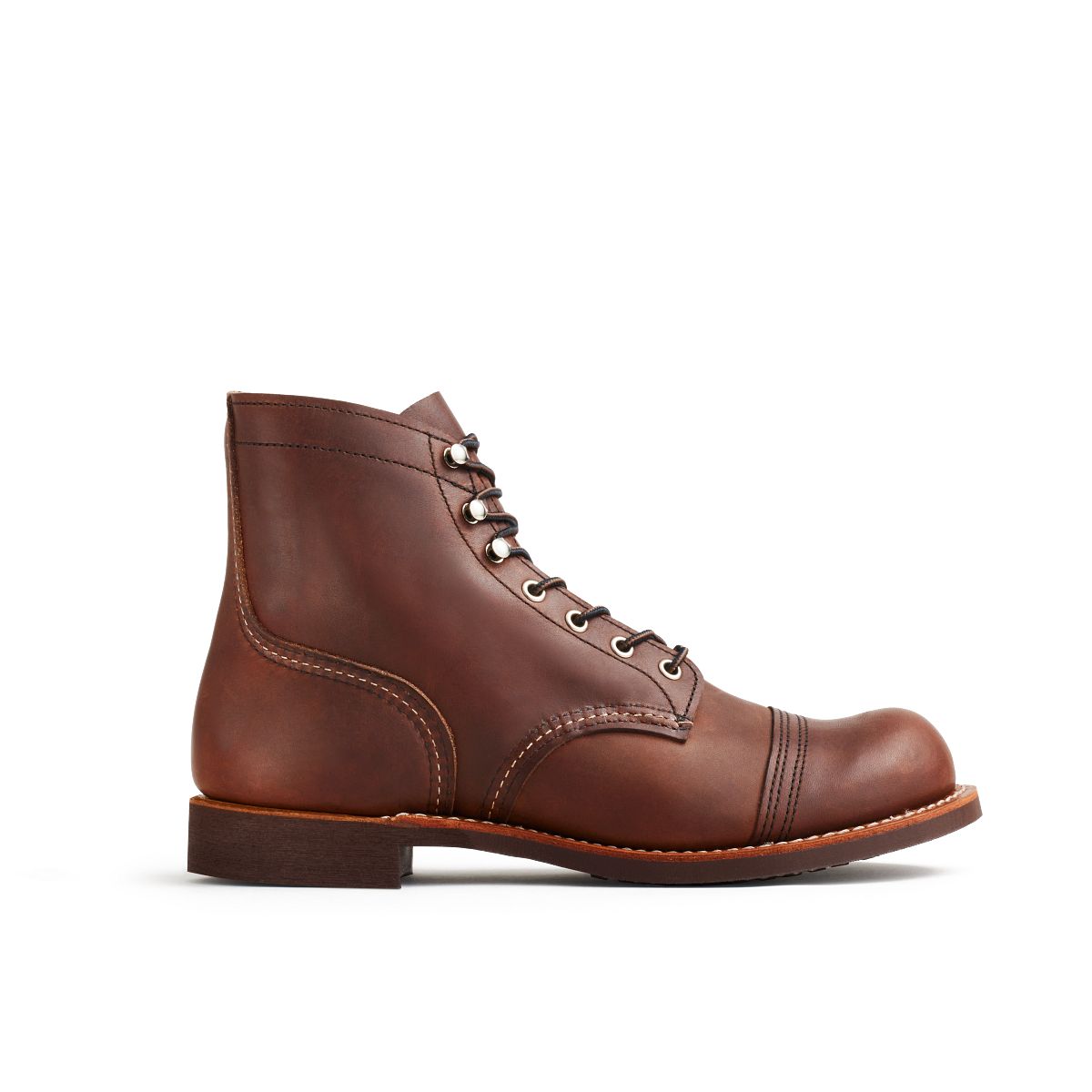
Most companies on this site publish one sentence about where their products are made, and our job is to go and check whether the sentence holds. Red Wing does something harder to fake. It publishes four origin labels, defines each one in writing, and then sorts its own catalog into them — including the boots that land in the bottom two. The Iron Ranger gets the top label. The reason that is worth anything is that we went and found the boots that don’t.
We verify manufacturing against primary sources, read what actual owners report, and never accept payment for rankings.
Which one is this, exactly?
“An Iron Ranger” is not one boot. It is a cap-toe pattern that Red Wing currently issues in several leathers and two outsole treatments, and the number on the box is the only thing that tells you which one showed up.
- #8111 — Amber Harness. The one reviewed here, and the one almost everybody pictures. Red Wing calls the leather “a heavyweight leather, oiled and waxed for performance, with visible natural marks.” It starts a warm reddish brown and darkens for years.
- #8084 — Black Harness. Same last, same construction, different hide.
- #8078 — Alpine Portage. A separate leather, frequently sold out, and the one owners in the review pool keep saying they wanted instead.
- #8088 — Iron Ranger Traction Tred. Same cap-toe upper on a wedge sole rather than the mini-lug. Not this boot.
- #3365 — the women’s Iron Ranger short boot. A different last and a different style number.
One oddity worth naming, because this site exists to resolve exactly this kind of thing. The browser tab on Red Wing’s own #8111 page reads “Men’s Iron Ranger 6-Inch Boot in Dark Brown Leather.” The page itself — the product name, the colour selector and the leather description — says Amber Harness, three times. The metadata is stale; the page is current. We have named it the way Red Wing names it on the page today, and if you are searching by colour, “dark brown” will take you to the amber boot.
What Red Wing’s badge actually means
The #8111 product page carries a badge that reads, with no qualifier attached, Made in USA. On this site that would normally be the end of the origin question. It is not, because Red Wing has gone to the trouble of telling you what its badges mean, and the meaning is more specific than the words.
Here are the four labels, in Red Wing’s own wording, from its Made In USA page:
- Made In The USA — “Built start to finish in the USA, using American labor and over 95% USA-made materials. No shortcuts, just boots built with pride.”
- Made In The USA With Imported Parts — “American workers handle every step — from stitching to final assembly — but some of the materials are carefully selected, premium, globally-sourced components.”
- Made In The USA With Imported Components — “We cut S.B. Foot Leather into components here in the U.S., then send them out for stitching. Once they’re back, we finish the job here in our U.S. factories.”
- Assembled In The USA With Imported Components — “S.B. Foot Leather, or other locally sourced leather, is stitched overseas, then we bring it all together in our U.S. factories.”
The Iron Ranger carries the first one. That is a real distinction and not a marketing gradient, and here is the check that proves it: on the day we wrote this, every badge on Red Wing’s men’s Heritage catalog page read “Made in USA” — twenty-six of twenty-six. On the men’s Work catalog page, the same badge field returned a different picture entirely: six boots labelled “Assembled in USA w/ Imported Components,” plus “Made in USA with Imported Parts” and “Made in USA with Imported Materials.”
Red Wing demotes its own boots when it has to. That is the entire reason the Iron Ranger’s badge is worth something, and it is a standard most brands in this archive do not meet.
Two honest asterisks. First, Red Wing’s own definition of its top label is “over 95% USA-made materials,” not all of it — the company is telling you there is a remainder, and it does not say what the remainder is. We report the number Red Wing published rather than rounding it up. Second, that Work catalog turned up a fifth wording, “Made in USA with Imported Materials,” which is not one of the four labels Red Wing defines. A four-tier system with five labels in the wild is a small inconsistency, and we would rather flag it than pretend the scheme is tidier than it is.
The sizing problem is the whole purchase
If this review saves anyone anything, it will be here. The Iron Ranger is built on Red Wing’s No. 8 last, which the company describes as having “a bump toe to fit a wide variety of foot shapes, allowing toes to move more naturally.” In practice that last runs long and, for a lot of feet, narrow, and it does not behave like any sneaker size you know.
The conventional advice — drop a half size to a full size from your sneaker — is roughly right and is also how people end up with a boot they cannot wear. One owner walked through it in detail: he wears a 9.5 D in running shoes, followed the advice down to an 8.5 D, and found them “extremely tight,” adding that he “should have gone for 8.5EE instead.” He got the length right and the width wrong. That is the characteristic failure of this boot.
Red Wing’s own aggregated fit data on the #8111 page says the same thing in numbers. On its runs-small-to-runs-large scale, where 3 is true to size, length averages 3.17 — a slight lean toward running large, consistent with sizing down. Width averages 2.98 — dead centre, which sounds reassuring and is not: a mean of exactly neutral with this much spread means the D width fits some people and pinches others, and the average tells you nothing about which one you are.
The practical instruction, which multiple owners arrive at independently: get measured on a Brannock device before you buy, and treat EE as a normal option rather than a special case. The boot is offered in D and EE from 4.5 through 14. If you have ever blown out the side of a shoe, you want the EE. One owner with feet that destroy ordinary footwear reported three years of daily wear and was sending them out for a re-tread rather than a replacement.
What it is actually like to own
The construction is the part nobody argues about. A Goodyear leather welt, a steel shank, leather insoles over a cork midsole that compacts to the shape of your foot, and a Vibram 430 mini-lug outsole. Red Wing lists it as resoleable and runs its own repair service, which is the whole economic argument for the boot: the upper is expected to outlive several soles.
The leather comes from S.B. Foot Tanning Company, which Red Wing owns and which sits in the same town as the factory. Red Wing describes the hides as “a natural by-product of the American food industry.” Amber Harness is full grain and oiled, and it behaves accordingly: it scuffs, it creases across the vamp within a week, and it darkens. Owners who oil it aggressively report it going very dark indeed — one, two years in, wrote that had he known how dark it would get he would have bought a different colour. That is not a fault. It is what an oiled harness leather does, and it is most of why people buy it.
Then there is the break-in, which is genuinely rough and which the marketing copy does not prepare anyone for. The leather arrives stiff and the insole is flat and hard until it packs out. Owners describe the first days as painful and the first few weeks as an argument. One put it as well as anyone: if this is your first boot of this construction, “it is going to be a bad experience until they break in,” and then noted, correctly, that any boot built this way behaves the same. Expect somewhere between two weeks and three months depending on how much you wear them. Thick socks, short sessions, and patience.
What it is not: waterproof, insulated, or safety-rated. Red Wing states this plainly — Heritage boots “are not intended for heavy duty work use as they do not meet the safety requirements of modern job sites.” Oiling makes the leather water-resistant, not waterproof. If you need a toe cap that protects your toes rather than one that looks good, you are in the wrong catalog, and Red Wing has an entire other one.
The sole generation trap
This is the one buying hazard specific to ordering online, and it is worth a section.
The Iron Ranger has been sold under the same style number across two different outsoles. The current specification is the Vibram 430 mini-lug. Earlier production used a nitrile cork sole with a different look and a different feel underfoot. At least one owner in the current review pool documented receiving the older sole rather than the Vibram — he was happy about it, but he was also expecting it, and most buyers will not be.
Why this matters for reading the ratings: a long-lived retail listing pools every owner who ever bought under that number, across both sole generations and a decade and a half of production. When you read a rating on a boot like this, you are reading a blended verdict on more than one product. We have used that pooled number because it is the honest one to publish, but it is worth knowing what is inside it.
If the sole matters to you, confirm the current specification before buying, and check the box and the boot the day it arrives.
What owners actually say
The pool behind the store listing is 4.5 out of 5 from 1,860 ratings — 82% five-star, 7% four, 4% three, 1% two, 6% one. Red Wing’s own site carries a second, independent pool on the same boot: 4.4 from 992 reviews, with 812 of 917 respondents — 89% — saying they would recommend it. Two separate pools, two separate populations, landing within a tenth of each other. That is about as good a cross-check as this category offers.
The criticism here is real, and it is almost entirely about fit, break-in and cost rather than about the boot failing. We say that rather than manufacturing balance. Across both pools the complaints sort into four piles:
Sizing, by a distance. The retailer’s own synthesis of its reviews puts it bluntly: customers “disagree on the fit, with some finding them true to size while others say they run large.” They are both describing the same last from different feet. This is the single largest source of unhappy owners and the one most likely to be your problem.
Stiffness and break-in. The same synthesis notes the leather “receives mixed feedback — while some find it soft yet thick, others describe it as very stiff.” It is stiff. It is supposed to be. This is a quirk of the category, not a defect, but it converts into one-star reviews from people who did not expect it.
Value. This is the most interesting number Red Wing publishes about its own boot. On its own site, owners score Quality at 4.7 and Value at 4.1 — the widest gap in Red Wing’s own ratings for this product. Owners think the boot is excellent and think it costs a lot. Both things are true and they are not in conflict.
The shape of the one-star tail. Six percent one-star against one percent two-star is an unusual distribution. A product that wears out badly produces a fat two- and three-star band as owners grudgingly downgrade it over time. An inverted tail like this one — almost nothing in the middle, a cluster at the bottom — is the signature of a purchase that either works or doesn’t on arrival. Which is what a boot with a difficult last and two sole generations under one number would be expected to produce. Red Wing’s own pool has a flatter, fatter tail (47 three-star, 56 two-star, 55 one-star of 992), which is what you get when the buyer was measured in a shop first and is grading the boot rather than the guess.
What is largely absent from nearly three thousand combined ratings matters too. There is very little about welts failing, soles separating, eyelets tearing out, or uppers splitting. The durability reports run the other way, at length: twelve years of service before retirement, a thousand-plus miles across three continents, three years of daily wear on feet that destroy ordinary shoes. When people are unhappy with an Iron Ranger it is nearly always because of how it fit on day one.
One last detail, and it belongs on this site more than most. Red Wing lets reviewers filter its boot reviews by a field labelled “Is Made in USA important” — the company asks its own customers whether origin factored into the purchase, and publishes the answer as a filter. We have not seen another footwear maker do that.
Made in USA Verification
- The product page carries the unqualified badge. Red Wing’s own #8111 page displays a badge reading exactly “Made in USA” — not one of the three qualified variants the company also uses. Read live on the manufacturer’s site, not a retail listing.
- The label is defined in writing by the maker. Red Wing’s Made In USA page defines its top tier as “Built start to finish in the USA, using American labor and over 95% USA-made materials,” and heads the section: “When we say that a product is Made In the USA, we mean it. From tanning to cutting to stitching and assembly, American workers touch every pair of footwear that earns the label.”
- The Heritage line is named explicitly. From Red Wing’s own article: “The Red Wing Heritage boots are Made in the USA. They are made using premium leather from our own S.B. Foot Tanning Company located in Red Wing, Minnesota.” The Iron Ranger is listed by number in that article as Heritage #8111.
- The plants are named and dated. “Red Wings have been made for 120 years and counting in Red Wing, Minnesota… we’ve been building boots in our plant in Potosi, Missouri, since 1994. And we’re just getting started. A new facility in Clarksville, Arkansas, will expand the manufacturing operations we’ve conducted there since 2003.”
- The tannery is owned, not contracted. “All Red Wing leather comes from our own tannery, S.B. Foot Tanning Company, located in Red Wing, Minnesota. S.B. Foot uses hides sourced as a natural by-product of the American food industry.” Vertical integration on the single most expensive input in a boot is uncommon and is the strongest part of this verification.
- The company does not claim more than this, and says so. On the same article: “Red Wing makes boots all over the world, using the best elements from around the world. But whenever possible, we choose to make our boots right here in the USA.” A brand-level “Red Wing is American” verdict would be wrong. A style-level one is what the company itself supports.
- Verified against the company’s own counter-examples. Checked the same day: the men’s Heritage catalog returned 26 badges, all “Made in USA.” The men’s Work catalog returned six “Assembled in USA w/ Imported Components,” one “Made in USA with Imported Parts” and one “Made in USA with Imported Materials.” The scheme discriminates in practice.
- What we did not verify. Red Wing does not publish the country of origin of the Vibram 430 outsole, the nickel eyelets and hooks, the steel shank, the cork midsole or the thread, and we did not audit its supply chain. The company’s own top-tier definition says “over 95%” USA-made materials, which by its own wording leaves a remainder it does not itemise. Nothing here transfers to Red Wing’s separately branded Irish Setter line or to any style carrying one of the three qualified badges — check the badge on the style you are actually buying.
- A small internal inconsistency, reported rather than smoothed over. The #8111 page describes “Steel Speed Hooks” in its feature bullets and lists “Nickel Eyelets And Hooks” in its specification table, on the same page. We have reproduced both below rather than choosing one.
Specifications
| Model | Iron Ranger® — Men’s 6-Inch Boot in Amber Harness Leather |
| Style number | Heritage #8111 (black is #8084, Alpine Portage #8078, Traction Tred version #8088, women’s short boot #3365) |
| Leather | Amber Harness — full grain, oiled; tanned at S.B. Foot Tanning Company, Red Wing, Minnesota |
| Construction | Goodyear leather welt |
| Outsole | Vibram® 430 Mini-Lug (earlier production used a nitrile cork sole under the same style number) |
| Last | No. 8, bump toe |
| Hardware | Nickel eyelets and hooks per the specification table; described as steel speed hooks in the same page’s feature bullets |
| Shank | Steel |
| Footbed | Leather insole over cork midsole; moulds to the foot with wear |
| Height | 6 inch |
| Sizes | 4.5 to 14 |
| Widths | Regular (D) and Wide (EE) |
| Resoleable | Yes — Red Wing operates its own repair service |
| Safety rating | None. Red Wing states Heritage boots do not meet modern jobsite safety requirements |
| Origin | Made in USA (Red Wing’s unqualified tier: “built start to finish in the USA, using American labor and over 95% USA-made materials”) |
| Factories | Red Wing, Minnesota (since 1905); Potosi, Missouri (since 1994); Clarksville, Arkansas (since 2003) |
| Company | Red Wing Shoe Company, Red Wing, Minnesota, founded 1905 by Charles Beckman |
| Owner rating | 4.5 out of 5 — 1,860 ratings (82% five-star, 7% four-star, 4% three-star, 1% two-star, 6% one-star). Red Wing’s own site: 4.4 from 992 reviews, 89% would recommend |
How it compares
Against the Thorogood American Heritage 8-inch moc toe, the other American boot in this archive, the split is cleaner than the gap between them suggests. Thorogood is union-made in Wisconsin on a wedge sole, is softer out of the box, and asks far less of you in the first month. The Iron Ranger is stiffer, harder to size, and built on a lug outsole with a steel shank and a cap toe that takes abuse. If you want a boot you can wear home from the shop, Thorogood. If you want the one that will still be on its second or third sole in a decade, and you are willing to serve the break-in sentence, the Iron Ranger.
Against Red Wing’s own catalog, the honest comparison is the Classic Moc #875, which shares the factory, the tannery and the badge but uses a Traction Tred wedge. The wedge is more comfortable standing on concrete; the mini-lug is better on anything uneven or wet. Neither is a work boot in the safety sense.
Against imported heritage-styled boots — and there are a great many, cut to look exactly like this one — the Iron Ranger costs several times as much and will read as identical in a photograph. What the extra buys is a welt that can actually be resoled by a manufacturer that still runs the repair department, a tannery the company owns, a factory the company names, and an origin badge the company is willing to withhold from its own boots. Whether that is worth the difference is a question for you. Whether those four things are real is a question for us, and the answer is that they are.
Pros: Red Wing’s unqualified Made in USA badge on the product page, backed by a published four-tier definition the company demonstrably applies against itself; leather tanned in-house at a tannery Red Wing owns in the same town as the factory; Goodyear leather welt, steel shank and cork midsole, resoleable through the manufacturer’s own repair service; three named US plants with dates; a cap-toe pattern that has outlasted every fashion cycle since the 1930s; durability reports running to twelve years and thousands of miles with almost no structural complaints in nearly three thousand combined ratings; two independent owner pools agreeing within a tenth of a point; D and EE widths from 4.5 through 14; leather that improves with age rather than merely surviving it.
Cons: The No. 8 last is genuinely difficult to size by mail and is the single largest source of unhappy owners, with the width more often wrong than the length; a break-in that is painful for two weeks to three months and that a steady stream of buyers meet without warning; owners rate value a full half-point below quality on Red Wing’s own site, the widest gap in its data for this boot; a 6% one-star share against a 1% two-star share, the shape of a purchase that goes wrong on arrival rather than in service; one style number covering two outsole generations, so the pooled rating blends more than one product and an older nitrile sole can still turn up; not waterproof, not insulated and not safety-rated, which Red Wing states plainly and buyers still miss; amber harness leather that darkens substantially with oiling, sometimes past what the owner wanted; Red Wing’s own top tier is defined as “over 95%” USA-made materials, with the remainder unitemised; no published origin for the Vibram outsole, hardware, shank or thread; and a fifth origin wording in the wild that the company’s four-label scheme does not define.
Should You Buy It?
Yes — with one caveat.
Buy it if you want one pair of boots to last the next decade from a company that tans its own leather in the town it is named after, names its three American factories, and publishes an origin scheme strict enough that it hands its own work boots a lesser label. The caveat is sizing, and it is the only thing that ruins this purchase: the No. 8 last runs long and the D width is unforgiving, so get measured on a Brannock device before you order, treat EE as a normal option rather than a special request, and if you are between sizes go for the width rather than the length. Do not buy it if you need comfort in the first month, if you need waterproofing, insulation or a safety toe — Red Wing says plainly this boot is not rated for modern jobsites — or if the purchase only makes sense to you at what an imported lookalike costs, which it will not. And check what arrives: confirm the outsole matches the current specification, because this style number has carried two of them. Get the fit right and the rest of it takes care of itself for about ten years at a stretch.
The exact model we reviewed — Red Wing Heritage Iron Ranger, Heritage #8111 in Amber Harness — is stocked at the Buy American Store.
Buy the Red Wing Iron Ranger 8111 at the Buy American Store
#8111 is the Amber Harness boot on the Vibram 430 mini-lug. The black is #8084, Alpine Portage is #8078, the wedge-soled version is #8088, and the women’s short boot is #3365 — all different style numbers. Sizes run 4.5 to 14 in D and EE.
The Company That Grades Its Own Boots
How a Minnesota bootmaker ended up publishing four origin labels and sorting its own catalog into them — what Red Wing makes in Minnesota, Missouri and Arkansas, why it owns a tannery, and which of its lines the top badge does not cover.