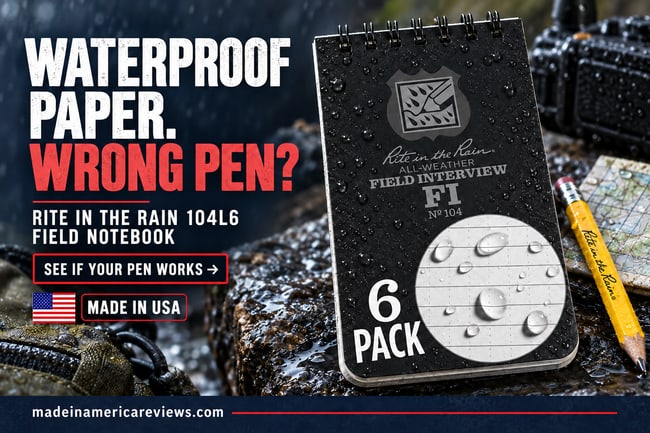
Rite in the Rain’s 104L6 Field Interview Notebook is built around a promise that ordinary pocket notebooks cannot make: your notes should survive the weather. The exact six-pack contains six black 3-by-5-inch top-spiral books, each with 100 all-weather pages, a field-interview form on the front of every sheet and ruled notes on the back. The current exact listing showed 4.6 out of 5 from 981 global ratings when checked October 14, 2026. Owners overwhelmingly like the organization and wet-weather reliability. The catch is that the paper is only as useful as the writing instrument you choose.
We verify manufacturing against primary exact-model evidence, analyze recurring owner feedback, and do not accept payment or free products for rankings. This is an independently researched review, not a hands-on test.
This review covers Rite in the Rain item 104L6, UPC 632281102298: six black Field Interview notebooks with 3-by-5-inch sheets. It is not the single-book item 104, a yellow universal-pattern memo book, a tactical notebook, or a generic bundle assembled by a reseller. The six-pack uses the same No. 104 book format, but the exact package identifier matters because the owned Store route and owner count both land on 104L6.
The form is more specialized than the paper
The most distinctive feature is the page layout. Each sheet presents a field-interview form on the front and ruled space on the back. The form organizes names, identifiers, times and incident details, while the reverse side leaves room for narrative notes. Rite in the Rain also prints imperial and metric rulers and Miranda Rights inside the cover. This is not a blank pocket journal with a police-themed cover; it is a purpose-built documentation tool.
That specialization is a strength for patrol officers, investigators, security teams and field-service workers who need the same facts in the same place every time. The exact-listing owner summary repeatedly points to organization as a major advantage, including use for traffic accidents and domestic incidents. A structured form can reduce the chance that a hurried note omits a name, time, vehicle detail or follow-up fact.
It is also the clearest reason not to buy this model. Hikers, birders, mechanics and general note-takers may have no use for interview fields or Miranda text. Rite in the Rain sells many universal, ruled, grid and profession-specific formats. If you mainly want waterproof paper, choose the page pattern first and the cover color second.
What all-weather paper can and cannot do
Rite in the Rain says its wood-based paper repels water, sweat, grease and mud rather than turning to pulp when wet. The maker also says the paper remains recyclable with ordinary printed paper, unlike synthetic waterproof sheets. Owners on the exact 104L6 listing consistently report that the notebook works in rain and other rough conditions, which supports the central weather-resistance claim.
Weather resistance does not make every ink weatherproof. The manufacturer’s own instructions are specific: use an ordinary No. 2 pencil or an all-weather pen when the page is wet. Standard ballpoints and permanent markers work when the page is dry. Water-based inks can bead or wash away. That distinction explains why the exact owner summary is positive about the paper but mixed on writing experience and ink durability.
The right expectation is durability under field conditions, not magic paper. Repeated soaking, abrasion and poor ink choice can still compromise a record. Let wet pages dry open when possible, and test the actual pen you intend to carry before trusting it on an important shift or trip.
Pocket size favors speed over long narratives
Each book measures about 3 inches wide, 5.25 inches tall and 0.375 inch thick. At roughly 0.12 pound per notebook, it fits a uniform, vest or jacket pocket without becoming a brick. The top-bound Wire-O construction keeps the long edge clear and allows a page to flip over the top rather than fighting a side spiral.
The compact footprint also limits handwriting space. The form works best for concise entries. Large handwriting, detailed witness statements or sketches can quickly overflow the 3-by-5-inch sheet. Owners who find the paper difficult to write on may be reacting partly to ink compatibility and partly to the small format. Gloves, cold hands and a broad pen barrel make that constraint more noticeable.
The black Polydura cover is flexible rather than rigid. It protects the page block from splashes and everyday abrasion while still bending in a pocket. The impact-resistant Wire-O binding is designed to keep its shape better than a common coil, but an exposed top binding is still the part most likely to catch on gear. A hard-cover or side-bound model is a better fit for someone who carries a notebook loose in a packed tool bag.
What owners actually report
The exact current route showed 4.6 out of 5 from 981 global ratings on October 14, 2026. The distribution was 78% five-star, 13% four-star, 7% three-star, and 1% each at two and one stars. That is a broad enough owner pool to treat repeated themes as meaningful, while still separating them from laboratory testing.
Weather performance leads the praise. Owners say the notebook continues to function in rain and other messy conditions. That aligns with the maker’s all-weather-paper claim and is the main reason to pay more than a disposable memo pad.
Organization is the second major strength. The preprinted interview fields help users capture information consistently, and the ruled reverse side preserves space for context. Buyers using the book for incidents, field contacts and other repeatable records value the format more than casual note-takers do.
Writing feel and ink durability are mixed. Some owners find the coated paper harder to write on, and feedback varies with the pen. That is not a minor accessory issue; it is the product’s central limitation. A notebook that survives rain but sheds the wrong ink has failed the practical task.
Value depends on whether all six books will be used. The six-pack lowers the per-book hassle for departments, teams and heavy users. One person trying the format for the first time may be better served by the single item 104. The owner record is broadly positive, but value opinions are mixed because a specialized six-pack solves a narrower problem than an ordinary notebook.
Made in USA verification
- Exact package: the manufacturer lists item 104L6 as the six-pack version of the Field Interview Notebook.
- Exact specifications: 3-by-5-inch gray all-weather sheets, 100 pages per notebook, black 19-gauge Polydura covers and rust-resistant Wire-O binding.
- Primary origin evidence: Rite in the Rain’s exact-item specification marks 104L6 “Manufactured: U.S.A.”
- Factory context: the maker says it has produced all-weather notebooks in its Tacoma factory since 1916.
- Scope: this verification applies to the exact 104L6 notebook package, not every pen, pouch or accessory sold under the brand.
The exact origin statement is unusually clear. It appears in the manufacturer’s own 104L6 specification rather than being inferred from company headquarters or a family-level marketing page. We therefore classify this exact notebook pack as Made in USA. The scope matters because accessory origins can differ; the notebook’s evidence should not be stretched into a blanket claim about every Rite in the Rain product.
Specifications
| Model reviewed | Rite in the Rain Field Interview Notebook six-pack |
| Manufacturer item | 104L6 |
| UPC | 632281102298 |
| Quantity | 6 notebooks |
| Sheet size | 3 x 5 inches |
| Pages | 100 pages / 50 sheets per notebook |
| Page pattern | Field Interview Form on front; ruled notes on back |
| Paper | Gray, 20-pound Rite in the Rain all-weather paper |
| Cover | Black 19-gauge Polydura |
| Binding | Top-bound rust-resistant Wire-O with rounded corners |
| Reference material | Imperial and metric rulers; Miranda Rights inside cover |
| Single-book size / weight | 3 x 5.25 x 0.375 inches / about 0.12 lb. |
| Origin | Manufactured in U.S.A. |
| Owner rating | 4.6 / 5 from 981 ratings, checked October 14, 2026 |
104L6 or an ordinary pocket notebook?
| Rite in the Rain 104L6 | Ordinary pocket notebook | |
|---|---|---|
| Wet conditions | Paper resists water, sweat, grease and mud | Common paper can wrinkle, smear or break down |
| Organization | Dedicated interview form plus ruled notes | More flexible but less structured |
| Pen choice | Needs compatible pencil or ink, especially when wet | Usually accepts a wider range of pens when dry |
| Writing area | Compact 3-by-5-inch sheet | Available in many larger formats |
| Bulk purchase | Exact route is a six-pack | Easy to buy one inexpensive book |
| Origin evidence | Exact-item U.S.A. manufacturing statement | Varies by brand and model |
Pros & cons
Pros: The exact item has a clear manufacturer-published U.S.A. origin statement; the all-weather paper is supported by a large, strongly positive owner record; the field-interview layout creates consistent information capture; each sheet combines a structured front with ruled narrative space; the compact top-bound form fits a pocket; Polydura and Wire-O construction are better suited to field wear than a disposable memo pad; the paper is wood-based and recyclable; and the six-pack works well for departments, teams and frequent users.
Cons: The specialized interview form is wasted on general note-taking; wet writing requires a pencil or compatible all-weather pen; owner feedback on writing feel and ink durability is mixed; the 3-by-5-inch page is cramped for long narratives, gloves or large handwriting; the flexible cover and exposed top binding are not as protective as a hard-cover design; buying six at once is excessive for a first-time user; and the notebook costs more than ordinary paper because its central benefit is resilience, not luxury.
Should you buy it?
Yes—if the form matches the work and the pen matches the weather.
Rite in the Rain 104L6 succeeds because it combines durable American-made paper with a genuinely useful field-interview layout. The 981-rating owner pool strongly supports weather performance and organization. Its weakness is equally clear: the wrong ink can turn a weatherproof page into an unreliable record, and the compact form is too specialized for casual journaling. Buy the six-pack for a team or repeated field use; buy a single No. 104 first if you are still testing the format.