Makers on this site fall into two camps. Some say “Made in the USA” and we go and check it. Some say nothing at all and we report the silence. SureFire does a third thing, and in six years of reading manufacturer origin pages we have seen almost no one else do it: it publishes a page explaining why it is not allowed to put those four words on its flashlights, and then tells you which of its products still carry them and why. That page is the reason this review exists, and it is also the reason the badge above says what it says rather than something stronger.
We verify manufacturing against primary sources, read what actual owners report, and never accept payment for rankings.
Which one is this, exactly?
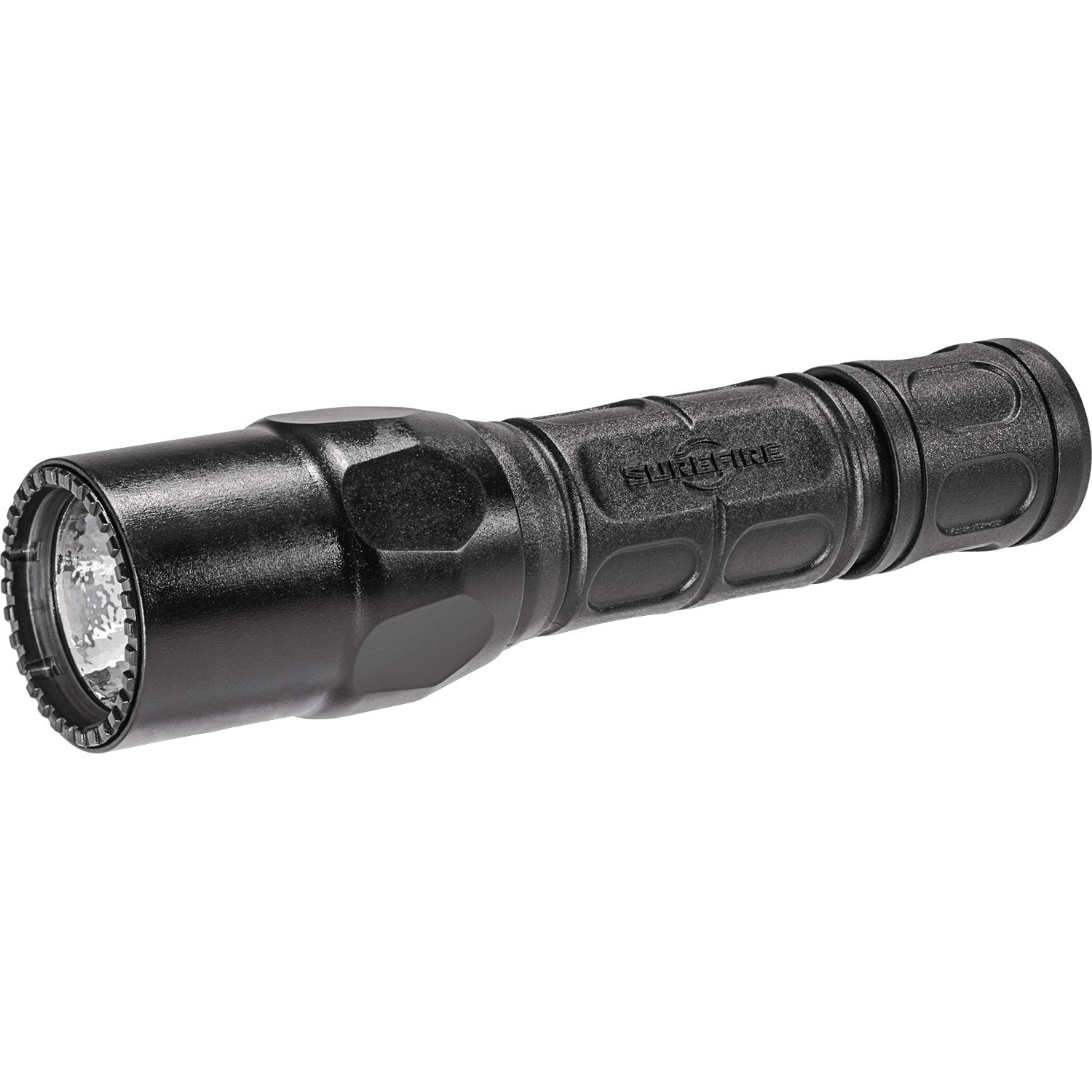
“A SureFire G2X” is not a flashlight. It is a family that currently splits into two lights sharing one body, one output pair and one price, and the difference between them is not cosmetic — it changes what happens the first time you press the switch in the dark.
- G2X Pro — part number G2X-D. The one reviewed here. Press or click the tailcap and you get 15 lumens first. Press again for 600. SureFire’s own description calls it “the consummate pro” and “the most versatile of the series.”
- G2X Law Enforcement Edition — part number G2XLE-BK. Same body, same emitter, same two outputs, reversed: 600 lumens first, 15 second. SureFire says it was “specifically designed at the request of Canadian law enforcement agencies.”
The Pro exists in four colours; the LE is black only. Everything else about them is shared: 600 lumens on high, 15 on low, 8,700 candela, a beam that reaches 187 metres, a polymer body with a hard-anodized aluminium bezel, two 123A lithium cells in the box, and a click tailcap. If you pick the wrong one you will not notice on a spec sheet. You will notice in a dark parking garage.
The switch order is the entire decision
SureFire does not let you reprogram the sequence. There is no mode memory, no hold-for-turbo, no software. The order is fixed in the tailcap you bought, and this is the single most common thing owners wish they had understood beforehand. One three-star review is titled “Nice light with one little catch,” and the catch is exactly this: “you can’t change the illumination settings so that the High setting comes before the Low setting. Other than that, it’s great, the High setting is really bright.” Another complains that “the normal light on it is way too dim” — which is not a fault, it is the 15-lumen low doing its job, in a light bought by someone who wanted 600 on the first click.
This is a quirk, not a defect, and it is disclosed. SureFire states the sequence in the first bullet of the product description on its own page. But it is worth being blunt about who each order suits, because the manufacturer is too polite to be:
Low-first — the Pro — is right if the light lives in a nightstand, a glovebox, a tool bag or a coat pocket, and most of what you do with it is find a fuse box, read a meter, check on a child, or walk a dog. Fifteen lumens does those jobs without wrecking your night vision or waking anyone, and it runs for 52 hours doing them. Six hundred lumens at arm’s length in a dark hallway is a genuinely unpleasant thing to do to your own eyes.
High-first — the LE — is right if the reason you are holding a flashlight is that something is wrong. Police, security, search-and-rescue, anyone who wants the first click to be the loud one. If that is your use case, buy the LE and do not talk yourself into the Pro because it comes in tan.
We reviewed the Pro because it is the one most people should own, not because it is the better light. They are the same light.
What it is actually like to own
The G2X is 5.2 inches long, 1.25 inches at the bezel, and 4.4 ounces with both cells in it. That is pocketable in a jacket and slightly too fat for jeans. The body is polymer — SureFire’s Nitrolon — and the bezel is aerospace aluminium with a Mil-Spec hard-anodized finish, which is a combination people get wrong constantly, including retailers. It is not an aluminium-bodied light. That matters in two directions: polymer does not conduct cold into your hand, does not dent, does not corrode, and does not transmit an impact to the emitter the way a metal tube does; it also does not shed heat, and it scuffs where anodized aluminium would scratch.
The beam is the part that is hard to convey on paper and is the reason people keep buying these. It is a parabolic reflector rather than a textured one, producing a defined hotspot with a wide, even spill around it. There is no focusing head. A three-star owner wanted one — “you’d think you could change the focus and concentrate the beam” — and then fairly added, “I should have read more closely. This is not an advertised feature.” He is right on both counts. Zoom heads are a source of failure and a source of dead space in the beam, and SureFire has never fitted one to this line.
It is rated IPX7, which means immersion, not just rain. The NATO stock number on the black Pro is 6230-01-617-9616 — the light is in the federal supply system, which is a quiet form of evidence about the failure rate that no marketing page can give you.
The battery question, which is the real cost
The G2X runs on two 123A lithium cells, included. On high it drains them in 1.5 hours. On low it goes 52. Those are SureFire’s own figures and they are honest ones, but the first is the number that generates complaints. A two-star owner wrote that it “drains batteries super fast on high setting. Even the supposedly superior batteries they sell you didn’t really last much longer than the cheap ones I got at work.” Another: “within a couple nights you have to change the batteries.”
Both are describing physics, not failure. Six hundred lumens out of two small cells for ninety minutes is a good result; it is simply a lot more current than a two-AA light draws. But 123As cost several times what alkaline AAs cost, they are not sold in every supermarket, and if you use high output routinely the running cost is real and recurring. That is a legitimate reason to buy something else, and we would rather say so than pretend it away.
Two things soften it. Low output is the default on the Pro and it runs for two days straight, so the expensive mode is the one you have to deliberately choose. And SureFire sells rechargeable lithium iron phosphate cells in the same form factor with a charger, which converts the running cost into a one-off. One more caution surfaced by an Arizona owner: 123A lithium cells are not meant to be stored at high heat, so a glovebox in a hot climate is the wrong home for this light. He gave it three stars for exactly that, and it is worth knowing before you buy rather than after.
What owners actually say
The pool behind this listing is 4.6 out of 5 from 792 ratings — 83% five-star, 10% four, 1% three, 1% two and 5% one. That one-star share is higher than most products in this archive and it is the first thing we went looking into. The same light in Tan and Yellow sits on a separate, larger listing carrying 4.7 from 1,665 ratings, which is a useful cross-check: it is the identical flashlight, and it rates higher on more than twice the evidence.
The honest headline is that the criticism is thin, and where it is thickest it is not about the flashlight. We say that rather than manufacture balance. A meaningful share of the one-star reviews are about the seller and the transaction rather than the product — opened packaging, a return policy, a rude phone call. One reviewer’s entire text is “DO NOT BUY, WASTE OF MONEY, RIP OFF,” with no stated reason. Those are real customer experiences and they are worth knowing about, but they tell you about a fulfilment channel, not about a light.
The tailcap switch is the genuine defect, and it is the one to watch for. Three separate patterns show up: a light that emits nothing at all when the button is pressed, a light that flickers on and off, and a light that will not stay on in constant mode. One owner — on his fourth SureFire, so not a novice — received a defective unit, was sent a replacement with “the same exact problem,” and had the seller insist the first was never faulty. He called SureFire directly and the company shipped him a replacement tailcap switch. That is the right ending and it is the one to copy: if the switch misbehaves, this is a warranty claim, not a quirk to live with. Do not accept a replacement from a reseller and do not try to fix it; go to the manufacturer.
Durability complaints exist but are rare and thinly described. The most substantive is a two-star owner who used his daily at work on high, and reported it broken at around six months — “not as durable as they claim.” Against that, the bulk of the five-star pool is people reporting multi-year service, several with the same light in a duty belt or a truck. One owner’s summary of the aggregate is as good as ours: the light is bright, the low and high are well chosen, and it keeps working.
The value objection is the fair one. A three-star reviewer weighed it against Fenix and Nitecore and concluded he was “not convinced as of yet that they are no better than the competition.” Another noted his imported light cost less and threw more light. Both are true. On raw lumens per dollar the G2X loses to imported lights, and anyone whose only criterion is brightness for the outlay should buy one of those instead. What they are not buying is a California-machined body, a warranty department that will send a tailcap to a private buyer, and an origin statement the maker is willing to argue against its own interest.
What is largely absent from nearly eight hundred ratings matters too. There is very little about the body cracking, the bezel failing, water ingress, or the emitter dying. When people are unhappy with a G2X Pro it is nearly always the switch, the battery cost, or the order the modes come in.
Made in USA Verification
- SureFire refuses the unqualified claim in its own words, and that refusal is the evidence. On its Built in the USA page the company writes: “Our best-in-class flashlights, hands-free lights, and WeaponLights are also designed, machined, tested, and assembled in the U.S., but if even one component of our products is entirely or substantially made abroad, we cannot legally mark it as ‘Made in the U.S.A.’” We do not upgrade that. The badge above is the qualified tier because the maker says the qualified tier is the truth.
- The imported component is named. SureFire does not leave it vague: “We do import a few components – most notably, the finest light-emitting diodes (LEDs) from top-notch manufacturers outside the country – to incorporate into our products.” That is the LED in this flashlight. It is not a trivial part.
- The American content is also named, and it is substantial. The same page describes “machining U.S.-sourced aluminum stock into illumination-tool bodies and components at our own Santa Ana turning center as well as assembling, testing, and shipping our products from our facilities in Fountain Valley, California.” Two named California facilities, one of them a turning centre SureFire owns. This is the opposite of a badge-engineering operation.
- The line SureFire draws is per product family, not per brand, and it draws it in public. “Many SureFire products, including our best-in-class sound suppressors, hearing-protection earplugs, rifle magazines, 123A lithium batteries, and pens are still marked that way… Our sound suppressors, rifle magazines, and pens are 100% Made in the U.S.A.” So the 123A cells that ship in the box with this flashlight are Made in USA; the flashlight around them is not. A brand-level verdict would get both halves wrong.
- The summary sentence is the tier, almost verbatim. SureFire closes that page: “All SureFire illumination products are designed, perfected, and manufactured in the U.S.A. with the finest materials and components sourced worldwide, and every SureFire product meets the criteria of the Buy American Act.” Manufactured in the USA, components sourced worldwide. That is the qualified badge as written.
- What we did not verify. SureFire does not publish the origin of the polymer, the reflector, the O-rings or the switch components, and we did not audit its supply chain. We did not independently confirm the Buy American Act assertion, which is a procurement standard with its own thresholds and is not the same test as the FTC one the origin badge uses. Nothing here transfers to another SureFire product, and in particular the unqualified claim SureFire makes for its suppressors, magazines and pens does not apply to this flashlight.
Specifications
| Model | G2X Pro, Dual-Output LED Flashlight |
| Part number | G2X-D-BK (black) — UPC 084871320351. Tan G2X-D-TN, Foliage Green G2X-D-FG, Yellow G2X-D-YL |
| Sibling model | G2XLE-BK — G2X Law Enforcement Edition, identical light with the output order reversed |
| High output | 600 lumens |
| Low output | 15 lumens |
| Output sequence | Low first, then high, by momentary press or full click (fixed; not reprogrammable) |
| High runtime | 1.5 hours |
| Low runtime | 52 hours |
| Peak beam intensity | 8,700 candela |
| Beam distance | 187 metres |
| Batteries | Two 123A lithium, included; SureFire states a 10-year shelf life |
| Switching | Click tailcap, momentary and constant-on |
| Body construction | Polymer body with high-strength aerospace aluminium bezel |
| Finish | Mil-Spec hard anodized |
| Sealing | O-ring and gasket sealed; IPX7 |
| Length | 5.2 in (13.2 cm) |
| Bezel diameter | 1.25 in (3.2 cm) |
| Weight with batteries | 4.4 oz (125 g) |
| NSN | 6230-01-617-9616 |
| Origin | Machined Santa Ana, California; assembled, tested and shipped Fountain Valley, California; LEDs imported (SureFire) |
| Company | SureFire, LLC, Fountain Valley, California, founded 1979 |
| Owner rating | 4.6 out of 5 — 792 ratings (83% five-star, 10% four-star, 1% three-star, 1% two-star, 5% one-star) |
How it compares
Against its own sibling, the choice is the switch order and nothing else, and we have given it a section above because it is the only decision that can go wrong.
Against the Maglite Mini Pro, the other American flashlight in this archive, the split is cleaner than the two brands’ reputations suggest. Maglite runs on AA cells you can buy anywhere and machines its bodies in Ontario, California; it also tiers qualified here, for its own reasons. The Mini Pro is the better light to hand to somebody, to leave in a drawer for years, and to feed cheaply. The G2X throws further, seals better, and is built around a duty-use failure rate rather than a household one. If the light is for the house, the Maglite argument is strong. If the light is for work, the G2X is the one.
Against imported tactical lights — Fenix, Nitecore, and the rest — the G2X loses on brightness, loses on rechargeability, loses on features, and loses badly on lumens for the outlay. It wins on exactly two things: a body machined in California by the company whose name is on it, and a manufacturer that will talk to a private owner about a broken switch. Whether those two things are worth several times the price of an imported light is a question this site cannot answer for you. What we can do is confirm that the two things are real, which in this category is not a given.
Against carrying nothing, which is what most people actually do: the honest note is that this is a 4.4-ounce light with a fat bezel. If the reason you have no flashlight is that you will not carry one, buy something smaller and carry it, rather than buying this and leaving it in a drawer.
Related reviews
Pros & Cons
Pros: An origin statement that argues against the company’s own commercial interest, naming the imported component rather than hiding it, and drawing the line per product family in public; two named California facilities including SureFire’s own Santa Ana turning centre where the bodies are machined from US-sourced aluminium stock; 600 lumens on high with 8,700 candela and a 187-metre reach from a light that fits a coat pocket; a 15-lumen low that runs 52 hours and preserves night vision, which is the setting most owners actually use; a polymer body that shrugs off cold, corrosion and impact in ways an aluminium tube does not; a hard-anodized aerospace aluminium bezel and O-ring and gasket sealing rated IPX7 for immersion rather than splash; a NATO stock number, which is a failure-rate statement no brochure can make; 123A lithium cells included, themselves marked Made in USA by SureFire, with a stated ten-year shelf life; no zoom head and no software, so there is very little that can fail; a warranty department that ships replacement tailcaps to private owners who call; four colours in the Pro and a factory sibling for anyone who needs the outputs reversed; and a review pool in which the body, bezel, sealing and emitter are essentially absent from the complaints.
Cons: The maker itself says this light cannot be marked Made in the USA, and the imported part is the LED rather than a screw; a fixed low-then-high output order that cannot be reprogrammed and that a steady stream of owners buy without understanding, leaving them with the wrong light; 123A lithium cells that cost several times what supermarket alkalines cost, are not sold everywhere, and drain in 1.5 hours of high output; a manufacturer caution against storing those cells in high heat, which rules out a glovebox in a hot climate; a tailcap switch that is the one genuine recurring defect, appearing as no output, flicker, or failure to stay on, and which at least one owner met twice in a row; a 5% one-star share that is high for this archive, much of it about the selling channel rather than the flashlight, which is still a real buying experience; no rechargeable option in the box and no focusing head; a 4.4-ounce, 1.25-inch-bezel body that is pocketable in a coat and not in jeans; conspicuously worse brightness for the money than imported competitors, which several owners say plainly; at least one credible report of failure at around six months under daily high-output work use; and no published origin for the polymer, reflector, seals or switch components.
Should You Buy It?
Yes — with one caveat.
Buy it if you want a light built to a duty standard by a company that machines the body itself in California and is candid to the point of self-harm about the one part it imports. Buy the Pro — part number G2X-D — if the light will spend its life finding fuse boxes, checking on sleeping children and walking dogs, because the 15-lumen low comes first and runs for two days. Buy the LE, part number G2XLE-BK, if the reason you are reaching for a flashlight is that something has gone wrong, because it puts the 600 lumens first; the order is fixed in the tailcap and you cannot change your mind later. That is the caveat, and it is the only one that ruins the purchase. Do not buy it if your measure is brightness for the money, if you want rechargeable out of the box, if you want a zoom head, or if buying 123A lithium cells for the rest of the light’s life would irritate you — all four are legitimate and all four point at a different flashlight. And check the tailcap the day it arrives: no light, a flicker, or a switch that will not hold constant-on is the one real defect in this pool, and it is a warranty claim to SureFire directly rather than something to live with or hand back to a reseller. Get the right one of the two and it is a twenty-year light.
The exact model we reviewed — SureFire G2X Pro, part number G2X-D-BK in black — is stocked at the Buy American Store.
Buy the SureFire G2X Pro at the Buy American Store
G2X-D-BK is the black Pro, low output first. The Tan, Foliage Green and Yellow Pros are G2X-D-TN, G2X-D-FG and G2X-D-YL. The G2XLE-BK Law Enforcement Edition is the same light with high output first and is a different part number.
The Company That Explains Why It Can’t Say Made in USA
How a Fountain Valley company that machines its own flashlight bodies ended up publishing an argument against its own origin badge — what SureFire makes, which of its products still carry the unqualified claim, and how to read the line it draws.