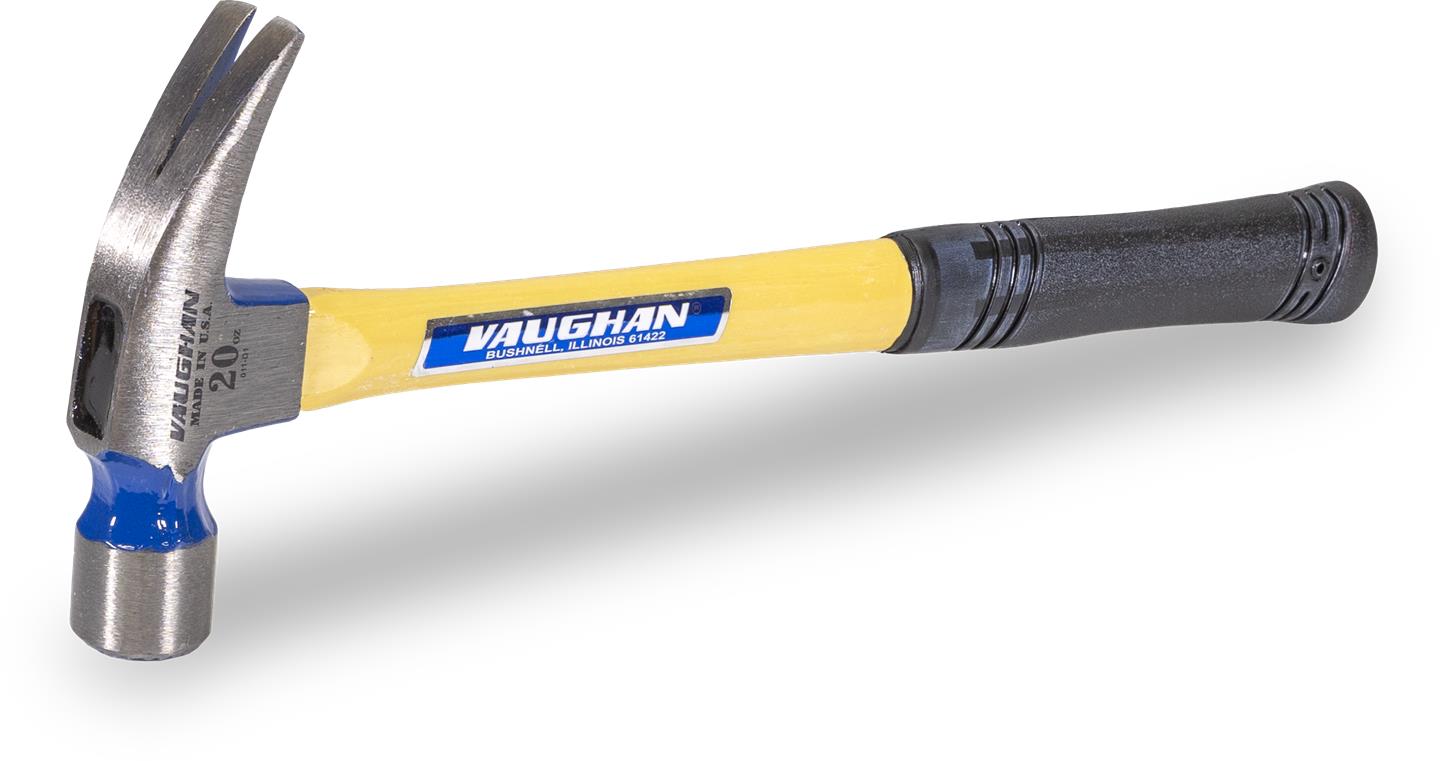
The hammer on this page has been made in the same shape, under the same three-digit name, since before most of the tools it competes with existed. What has changed is everything around it. Vaughan & Bushnell no longer exists as a company — MARSHALLTOWN bought its assets, and the 999 Series now lives on MARSHALLTOWN’s website under new part numbers. The catalogue name you have used for thirty years is filed as a “Legacy ID.” And the new owner now describes this one hammer’s origin two different ways, on two pages it controls, in the same week. That last part is why this review exists.
We verify manufacturing against primary sources, read what actual owners report, and never accept payment for rankings.
Which one is this, exactly?
“A Vaughan 999” is not a hammer. It is a series with thirteen current members across two handle materials, four head weights, two face types and five handle lengths, and several of them differ from each other by one letter. Buying the wrong one is easy, and the part number is the only thing that settles it.
This review is of the fiberglass-handled 999 Series framer in the 20 oz milled-face, 16-inch configuration. MARSHALLTOWN lists it as part number VN10538. Vaughan sold the identical hammer for decades as the FS999ML, and MARSHALLTOWN still prints that designation on the product page under the heading “Legacy ID.” Both numbers describe the same tool. Here is the whole fiberglass family, read from MARSHALLTOWN’s variant table:
- VN10538 — FS999ML. Milled face, 16 in. handle. The one reviewed here.
- VN10528 — FS999M. Milled face, 14 in. handle. Same head, two inches shorter.
- VN10516 — FS999L. Smooth face, 16 in. handle.
- VN10508 — FS999. Smooth face, 14 in. handle. The base model of the fiberglass line.
And the hickory side, which is a different hammer with the same name. The wood-handled 999 Series runs to nine variants: VN10500 / 999 and VN10510 / 999L (20 oz smooth, 14 and 16 in.), VN10530 / 999ML (20 oz milled, 16 in.), VN10620 / 606M and VN10602 / 606S (28 oz, 18 in.), VN10720 / 707M, VN10701 / 707 and VN10702 / 707S (32 oz), and VN12320 / 505M (24 oz milled, 17 in.). If you want the classic triple-wedged hickory 999, those are the numbers — and the section below on owner data explains why we are not reviewing one of them today.
Do not confuse any of this with the Vaughan 99. The Vaughan 99, which we have reviewed separately, is a 16 oz rip-claw nail and trim hammer on a 13-inch hickory handle, now catalogued as part VN12400. One nine, not three. It is a lighter tool for a different job, and it is the Vaughan most people own.
What MARSHALLTOWN’s purchase changed
Type vaughanmfg.com into a browser today and you do not arrive at Vaughan. You arrive at marshalltown.com, on a page that opens with a single sentence: “MARSHALLTOWN has purchased all assets of VAUGHAN & BUSHNELL Manufacturing Co. (VAUGHAN).”
That is the whole announcement, and it is worth reading precisely. An asset purchase is not a merger of two companies that both continue. The brand, the tooling and the catalogue moved; the corporate entity behind them did not survive the transaction. MARSHALLTOWN’s own framing is forward-looking — it says it “plans to leverage this incredible brand built by five generations of the Vaughan family” and to integrate the product line — which is the language of a buyer describing an intention, not a manufacturer describing a plant.
Three concrete things follow from it, and all three affect somebody buying this hammer.
Every part number was reissued. The numbers a carpenter has been ordering by since the 1970s are now secondary. MARSHALLTOWN’s variant tables carry a column headed “Legacy ID,” and FS999ML sits in it. The live part number is VN10538. Anything that still quotes you an FS999ML is quoting Vaughan’s old catalogue, which is fine as long as you know that is what it is doing.
The warranty is now MARSHALLTOWN’s. Covered in its own section below, because what it actually says is narrower than the way this hammer is usually sold.
And the origin wording moved with the brand. Which is where this gets interesting.
Two origin claims, one hammer
MARSHALLTOWN’s product page for the fiberglass 999 Series — the page that carries VN10538, the page a buyer would reach from the manufacturer’s own navigation — ends its description with five words that are not ambiguous:
“VAUGHAN’s 20 oz Fiberglass Handle 999® Series Hammers are designed to provide excellent overall balance while completing framing and demolition tasks… They are equipped with a fiberglass handle that has a hollow core to absorb shock. Made in the USA with Global Materials.”
That sentence is repeated as the final bullet in the feature list, and it appears verbatim on the hickory 999 Series page, on the replacement-handle pages, and across the rest of the Vaughan range. It is a deliberate, consistent, company-wide formulation. It is also the exact definition of the badge at the top of this page: American manufacturing, with materials the company does not claim are all domestic.
Now read the title of MARSHALLTOWN’s own store listing for the same hammer. Sold by MARSHALLTOWN, under the Vaughan brand storefront, carrying the part number VN10538, the listing is titled “VAUGHAN 999 Series Framer, 20 Oz Fiberglass, Assembled in the USA.”
“Assembled in the USA” and “Made in the USA with Global Materials” are not two ways of saying one thing. Under the FTC’s Made in USA standards they are different claims with different evidentiary bars. A qualified Made-in-USA claim asserts that the product is manufactured here from a mix of domestic and imported inputs. An Assembled-in-USA claim asserts only that the last substantial transformation — the putting-together — happened here, and it is the claim a company makes when it does not want to assert the stronger one. The same company is making both claims about the same hammer, in the same week, on two surfaces it controls.
Which one did we badge, and why. The manufacturer’s own website is the source of truth on this site, and a listing title is not a manufacturing statement — it is merchandising copy, written to a character limit, and this one is applied blanket-fashion to the whole Vaughan range including tools MARSHALLTOWN describes elsewhere as made here. The brand content further down the same listing reverts to the website’s wording: “VAUGHAN’s 999 Series Hammers are expertly crafted in the USA with Global Materials.” So the qualified badge stands. But we are not going to pretend the other wording is not there, because if you are buying this hammer specifically for where it is made, the discrepancy is exactly the thing you would want somebody to have checked.
What we could not verify. MARSHALLTOWN names no plant for the Vaughan hammers anywhere on its site. Vaughan & Bushnell manufactured in Hebron, Illinois for generations and the company profile still records that as the historic address, but MARSHALLTOWN has not published a post-acquisition statement about where the 999 Series is forged today, and we are not going to assert a plant location the current owner does not claim. Nor is there a component breakdown: “Global Materials” is the whole of the qualifier, and MARSHALLTOWN does not say which materials or from where. Its own brand page hedges the range too, saying it “proudly manufactures most products in the USA” — most, not all — which is one more reason the unqualified badge would have been the wrong call.
The handle is the whole decision
Vaughan built its reputation on hickory, and the romance of this brand is entirely wooden. The fiberglass version exists because the romance has a failure mode.
A wooden hammer handle is a consumable. It dries, it checks, it splits at the head where the wedges sit, and it breaks on overstrike — the swing where you miss the nail and catch the wood on the top edge of the handle instead. Every framer has done it. Hickory is genuinely replaceable, and MARSHALLTOWN sells the replacement handles and wedge kits as catalogue items, which is a virtue of the wooden line and not a defect. But replacing a handle is an evening at the bench, and on the hickory 999L the single most-repeated complaint in its owner pool is a handle that cracked at the head under light use.
The fiberglass 999 answers that directly. MARSHALLTOWN describes the handle as hollow-core fiberglass, chosen to absorb shock, and the replacement-handle listings add that it carries a black mould-on vinyl grip. Hollow-core matters: a solid fiberglass shaft transmits a surprising amount of the strike back into the wrist, and the void is what keeps this hammer from beating you up over a day of sheathing. The trade is that fiberglass does not feel like wood. It is stiffer, it is louder, and it does not warm up in the hand. Owners who love the hickory 999 almost universally say so in terms of feel, and that preference is real and is not a fault in either tool.
The milled face is the other fork in the road, and it is not a preference — it is a job description. A milled or “waffle” face is cut in a cross-hatch so the head bites the nail head instead of skating off it, which is why framers want it and why it is on this SKU. The same cross-hatch stamps its pattern into anything soft it touches. One owner with thirty years on this exact hammer puts it as plainly as it can be put: the milled face helps it hold the nail and not slip off the head, and it will also do damage to soft wood, and to your thumb, if you are not careful. If the hammer is going to live on finish work, buy the smooth-face FS999L instead. If it is going to frame, the milled face is the point.
What it is actually like to own
Twenty ounces is the swing weight American carpentry settled on, and this is a plain example of it: a 20 oz head with the deep throat, octagon neck, extra steel behind the striking face and smooth swept claws that have defined the 999 profile for decades, hung on a 16-inch handle. MARSHALLTOWN gives the finish as rust-resistant powder coat and the shipping weight as just under two pounds boxed. The long-neck geometry is the design argument — it lets you reach into a bay and land a square strike where a stubbier hammer would have you swinging at an angle.
The claws are worth a sentence of their own. This is a rip hammer, meaning straight claws rather than curved, and the swept profile on the 999 is well enough shaped that more than one owner reports using it in place of a cat’s paw for pulling. That is the demolition half of “framing and demolition tasks” doing real work.
What this hammer is not: it has no magnetic nail starter, no side nail puller, no anti-vibration grip system and no titanium anything. Vaughan sells hammers that have those — the California Framer line, the Dalluge titanium models — and they cost accordingly. The 999 is the plain one. Its entire proposition is geometry and balance at a working-tool price, and the owners who have been swinging the same one for twenty-five and thirty years are the evidence that the proposition holds.
The warranty is a defect warranty, not a promise
This hammer is routinely sold with the phrase “lifetime craftsmanship guarantee” attached, including on the Buy American Store page this review links to. The actual document is MARSHALLTOWN’s, it applies to the Vaughan line now, and it is narrower than that phrase suggests. Read in full on MARSHALLTOWN’s warranty page:
“All MARSHALLTOWN Company tools are warranted to be free from defective materials and workmanship. Any such defective product will, at our choice, be replaced or repaired free of charge if returned to us transportation charges prepaid… This warranty does not cover faults arising from normal wear and tear, damage, misuse or abuse of the tool.”
Three things in that are worth knowing before you need them. The remedy is theirs to pick — repair, replacement, or a credit memo at your net cost, at MARSHALLTOWN’s choice, not yours. You pay the freight to send the tool back. And wear and misuse are excluded by name, which is the clause that matters on a striking tool: a handle that breaks on an overstrike is not a defect in materials or workmanship, and neither is a face that has worn smooth after years of use. A handle that arrives cracked, or that fails at the head under ordinary swinging in its first weeks, is a different animal and is exactly what the warranty is for. Know which one you have before you ship it.
What owners actually say
The pool behind the store listing is 4.4 out of 5 from 104 ratings — 80% five-star, 4% four, 3% three, 5% two, 8% one.
Say the obvious thing first: that is a shallow pool by this site’s standards, and it should temper how much weight you put on the number. A hundred and four ratings clears our threshold and not by much. Compare it to the four-figure pools behind the Estwing hammers this tool competes with and the difference in statistical confidence is not small. It is also a bimodal pool, which is the more interesting fact: 80% of owners give it five stars and 13% give it one or two, with almost nobody in between. That shape usually means one of two things — a tool people either get on with completely or reject outright, or a listing where some buyers are not receiving what they think they ordered. There is evidence here for both.
The praise is unusually long-tenured, and that is the strongest thing in the pool. The five-star reviews are not first-impressions; they are people reporting decades. One owner writes that he has been swinging the same Vaughan hammer for thirty years and bought this one for a second tool belt. Another says twenty-five years on one hammer, and that the only thing better is titanium at many times the price. A third bought six of them so he would never be without one, after thirty-plus years in construction. A fourth used the same model for seven years, lost it on a job, and replaced it with the identical part number because it was still being made. In a pool this small, four independent reports of decade-scale service is worth more than the average.
The complaints are thinner than the one-star percentage suggests, and we will say so plainly rather than manufacture balance. There is no cluster of failures in the visible critical reviews — no pattern of heads flying off, no run of shattered handles, no warranty saga. What there is sorts into three piles, and only one of them is a defect.
One: a recent, specific and unresolved complaint that the hammer has changed. In February 2026 an owner rated it one star and wrote that the design had been updated, that the weight “doesn’t feel evenly distributed anymore,” that the handle he received was not 16 inches, and that it was “not fiberglass anymore. Brittle plastic.” We could not verify any of that. MARSHALLTOWN’s current specification still says hollow-core fiberglass and still says 16 inches, and one review is one review. But it is the most recent substantive criticism on the listing, it arrives after an ownership change, and it is the single report we would most like the manufacturer to answer. If you buy this hammer, measure the handle and flex it before the return window closes.
Two: the milled face, which is a quirk and not a fault. It marks soft wood and it will hurt a thumb. That is what a waffle face does. Anyone reporting this as a flaw has bought the wrong variant, and the smooth-face FS999L exists precisely for them. Do not return a hammer over this; buy the other one.
Three: fit, feel and expectation. A handful of owners find the fiberglass dead or unbalanced compared to wood. This is the hickory-versus-fiberglass argument arriving in the review pool, and it is a preference, not a defect.
One flag from the listing itself that is not an owner complaint but belongs here. The store listing carries a “Frequently returned item” notice. That is a signal generated from return rates rather than from review text, and it lines up uncomfortably with the 13% sitting at one and two stars. We cannot see the reasons behind it. Read it as a reason to inspect the tool on arrival rather than as a verdict on the hammer.
And a documentation defect worth naming, because it is the manufacturer’s own. The bullet list on MARSHALLTOWN’s own store listing for this fiberglass hammer includes the line: “Durable Construction: Features a rust-resistant powder-coated finish and a triple-wedged white hickory handle.” This hammer does not have a hickory handle. That is copy lifted from the wooden 999 and left on the fiberglass SKU. It is harmless in itself, and it is also precisely the kind of sloppiness that makes a buyer distrust a listing they are reading to work out what they are getting.
Made in USA Verification
- The claim comes from the manufacturer, for this product family, in writing, on its current site. MARSHALLTOWN’s product page for the Fiberglass Handle 999® Series Hammers — the page carrying part number VN10538 — closes its description and its feature list with “Made in the USA with Global Materials.” Read on marshalltown.com on 21 September 2026, not from a retail listing.
- The wording is consistent across the brand, which is what makes it credible. The same sentence appears verbatim on the hickory 999 Series page, on the fiberglass replacement-handle pages and on the hickory replacement-handle pages. A phrase applied this uniformly is a corporate position, not a stray line.
- We badged the qualified tier and did not upgrade it. MARSHALLTOWN says “with Global Materials” and we have carried that qualifier into the badge unchanged. It also describes itself as manufacturing “most products in the USA” — not all — which is a second reason the unqualified badge would have been wrong here.
- We did not suppress the weaker claim either. MARSHALLTOWN’s own store listing for VN10538 is titled “Assembled in the USA,” a materially different and legally weaker claim than the one on its website. The brand content on that same listing reverts to “expertly crafted in the USA with Global Materials.” We have badged the website’s wording, and flagged the conflict on this page rather than quietly picking the better of the two.
- The corporate change is documented by the acquirer. MARSHALLTOWN states on its own Vaughan category page: “MARSHALLTOWN has purchased all assets of VAUGHAN & BUSHNELL Manufacturing Co.” The historic vaughanmfg.com domain now resolves to that page.
- What we could not verify, and did not claim. No plant is named for the 999 Series by its current owner. No component-origin breakdown is published — not for the head steel, the fiberglass shaft or the vinyl grip. “Global Materials” is the entire qualifier and it is the entire badge. We have not extended this verification to any other Vaughan or MARSHALLTOWN product, and we have not carried the historic Hebron, Illinois address into a present-tense claim.
Specifications
| Model | VAUGHAN 999® Series Framer, Fiberglass Handle |
| Part number | VN10538 — legacy ID FS999ML, item ID 43057, UPC 051218105384 |
| Head weight | 20 oz |
| Face type | Milled (waffle) — grips nail heads, reduces slippage, marks soft wood |
| Claw | Rip (straight), smooth swept profile |
| Head design | Extra steel behind the striking face, deep throat, octagon neck, special long neck for power strikes in confined work |
| Handle | Hollow-core fiberglass, 16 in., black mould-on vinyl grip |
| Finish | Rust-resistant powder coat |
| Shipping weight | 1.92 lb boxed; shipping length 16.20 in. |
| Fiberglass siblings | VN10528 / FS999M (milled, 14 in.) · VN10516 / FS999L (smooth, 16 in.) · VN10508 / FS999 (smooth, 14 in.) |
| Hickory siblings | VN10530 / 999ML · VN10510 / 999L · VN10500 / 999 (all 20 oz) · VN12320 / 505M (24 oz) · VN10620 / 606M, VN10602 / 606S (28 oz) · VN10720 / 707M, VN10701 / 707, VN10702 / 707S (32 oz) |
| Replacement handles | Fiberglass and hickory replacement handles and wedge kits are catalogue items; MARSHALLTOWN states these are “Made in the USA with Global Materials” |
| Warranty | MARSHALLTOWN Lifetime Warranty — free from defective materials and workmanship; repair, replacement or credit memo at MARSHALLTOWN’s choice; return freight prepaid by the owner; excludes normal wear and tear, damage, misuse and abuse |
| Owner | MARSHALLTOWN, which purchased all assets of Vaughan & Bushnell Manufacturing Co. |
| Origin | Made in the USA with Global Materials (MARSHALLTOWN 999 Series product page). Component origins not published; no plant named by the current owner. The company’s own listing title for this part reads “Assembled in the USA” |
| Owner rating | 4.4 / 5 from 104 ratings (80% five-star, 4% four, 3% three, 5% two, 8% one) |
How it compares
Against the Estwing E3-16C, the comparison is the oldest argument in American hammers and the origin claims are not equal. Estwing states “Made in the U.S.A.” with no qualifier at all, which is a stronger claim than Vaughan’s current owner is willing to make, and it earns Estwing the unqualified badge this hammer does not get. The tools differ in kind as well: the Estwing is forged in one piece, head and handle together, so it cannot ever lose its head or split a handle — and it also cannot be rehandled, and it sends more shock into the arm than a hollow-core fiberglass shaft does. Estwing’s pool runs to thousands of ratings against this hammer’s hundred. If the single most important thing is an origin claim with no asterisk on it, buy the Estwing.
Against the Vaughan 99, the other Vaughan in this archive, this is a heavier tool for a rougher job. The 99 is 16 oz of rip claw on a 13-inch hickory handle, part VN12400, aimed at nail and trim work. It carries the same qualified badge, because it is the same company saying the same thing. Choose the 99 if you are hanging trim and driving finish nails; choose the 999 if you are framing, sheathing or pulling things apart.
Against the rest of the 999 Series, which is the comparison most buyers are actually making: the hickory line is the one with the reputation, the feel and the replaceable handle, and the fiberglass line is the one that does not split when you overstrike. Within the fiberglass four, the choice is milled versus smooth and 16 inches versus 14 — framing wants milled and long, finish work wants smooth. One practical note that has nothing to do with the tool: the hickory 20 oz milled 999ML, the closest wooden equivalent to this hammer, currently has essentially no owner-review history at all on the open market, while its smooth-faced hickory twin has a deeper pool with a better score. If you want the wooden one, that is the variant with evidence behind it.
Related reviews
Pros & Cons
Pros: A qualified American manufacturing claim made by the current owner in its own words, on its own current site, applied consistently across the whole Vaughan range rather than dropped on one page; a 999 head profile — deep throat, octagon neck, extra steel behind the face, long neck, swept rip claws — that carpenters have been buying on purpose for decades and that owners report using for twenty-five and thirty years on a single tool; a hollow-core fiberglass handle that removes the one failure mode the wooden version is genuinely prone to, without the dead transmission of a solid shaft; a milled face that does the job a framing face is supposed to do; claws swept well enough that owners use them in place of a dedicated puller; replacement handles and wedge kits still stocked as catalogue items; a lifetime warranty against defects from a company that has been making tools since 1890; and a plain working-tool proposition with no gimmicks, at a fraction of what the titanium framers in the same brand’s catalogue cost.
Cons: An owner pool of only 104 ratings, which clears our threshold without much room and is shallow enough that the 4.4 score should be held loosely — the Estwing this hammer competes with has more than a thousand; a strongly bimodal distribution with 13% of owners at one or two stars and almost nobody in the middle; a “frequently returned item” flag on the listing whose causes are not visible; a recent and unanswered one-star report that the hammer has been changed since the acquisition — wrong balance, a handle shorter than specified and “brittle plastic” instead of fiberglass — which we could not verify either way and which the manufacturer has not addressed; the manufacturer describing this one hammer’s origin two different ways, “Made in the USA with Global Materials” on its website and “Assembled in the USA” on its own listing title; no plant named by the current owner and no component-origin breakdown published; a bullet on the manufacturer’s own listing that describes this fiberglass hammer as having a hickory handle; a warranty that excludes wear, damage and misuse by name, picks its own remedy and makes you pay the return freight; a milled face that will mark soft wood and bruise a thumb; a fiberglass handle that a meaningful number of owners simply do not enjoy the feel of; and a part number that changed under new ownership, so half the internet is still quoting a catalogue that no longer exists.
Should You Buy It?
Yes — with one caveat.
Buy it if you want the 999 geometry — the long neck, the deep throat, the swept rip claws — on a handle that will not split the first time you overstrike, and if a qualified American origin claim is good enough for you. This is a plain framing hammer with no magnetic starter, no side puller and no anti-vibration system, and the people who have been swinging one for twenty-five years are not swinging it for the features. Buy the milled face, which is this SKU, if it is going to frame and demolish; buy the smooth-faced FS999L instead if it is going anywhere near finish work, because a waffle face will print itself into soft wood and into a thumb.
The caveat is the owner data rather than the hammer. A hundred and four ratings is a thin foundation, 13% of them sit at one or two stars, the listing carries a frequently-returned flag, and there is a recent unanswered report that the tool has changed since MARSHALLTOWN bought the brand. None of that is proof of anything. All of it is a reason to open the box properly: check the handle length against the 16 inches on the spec, flex the shaft, look at the head-to-handle joint, and swing it before the return window closes. Do not buy it if you want an origin claim with no qualifier on it — the Estwing E3-16C makes one and this does not. Do not buy it if what you actually want is the wooden Vaughan, because that is a different hammer with a different part number and you should go and get the right one. And do not buy it expecting the warranty to cover a handle you broke; it covers defects, it says so plainly, and you pay the postage.
The exact model we reviewed — the VAUGHAN 999® Series fiberglass framer, 20 oz milled face on a 16-inch hollow-core handle, part VN10538 / FS999ML, made in the USA with global materials — is stocked at the Buy American Store.
Buy the Vaughan FS999ML (VN10538) at the Buy American Store
FS999ML / VN10538 is the milled face on the 16-inch fiberglass handle. FS999M / VN10528 is the same head on a 14-inch handle; FS999L / VN10516 and FS999 / VN10508 are the smooth-faced versions. The hickory-handled 999, 999L, 999ML, 505M, 606M and 707M are different hammers on wooden handles, and the Vaughan 99 is a lighter 16 oz trim hammer.
Five Generations, 1869 to an Asset Sale
How one of the oldest hammer makers in the United States ended up as a brand inside another American tool company — what carried over, what the new owner will and will not say about origin, and how to read the part numbers now that the old catalogue is filed as “legacy.”