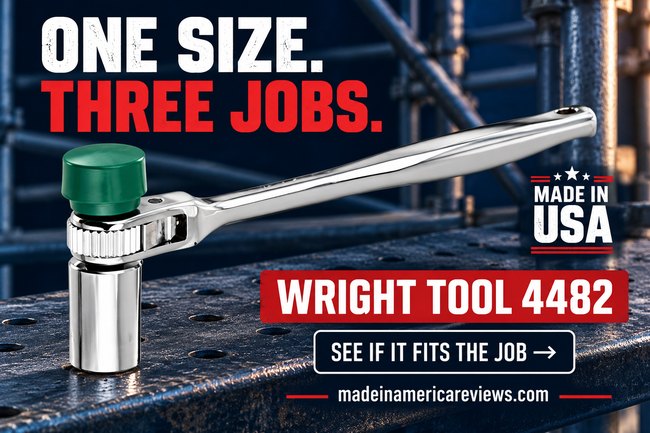
The Wright Tool 4482 is not a general-purpose socket wrench. It is a 10½-inch scaffold ratchet built around one job: turning the common 7/8-inch scaffold fastener while giving an erector a soft-face hammer in the same hand. Wright forges and manufactures the exact tool in Barberton, Ohio, and its fixed deep socket, compact pear head and replaceable hammer tip make sense on a scaffold deck. The tradeoff is equally specific: a 30-tooth single-pawl mechanism, one dedicated socket size and no listed renewal kit make it a poor substitute for a modern mechanics ratchet.
We verify manufacturing against primary exact-product evidence, analyze recurring owner feedback, and do not accept payment or free products for rankings. This is an independently researched review, not a hands-on test.
This review applies only to Wright Tool part 4482. Wright also lists the 4488 WrightGrip scaffold ratchet, the 4480 open-head ratchet and several round-head 1/2-inch-drive tools. Similar drive sizes and handle lengths do not make those models interchangeable with the 4482.
Three scaffold functions in one compact tool
The 4482 combines a pear-head ratchet, a fixed deep 7/8-inch socket and a green soft-face hammer tip. That layout reduces tool changes when assembling or adjusting systems that use 7/8-inch nuts. A scaffold worker can turn the fastener, seat or persuade components with the protected tip, and keep one hand free for positioning and balance.
Wright lists the tool at 10½ inches long with a 1 5/16-inch head diameter. The compact pear head is the right idea in crowded joints, while the contour handle keeps the tool narrower and simpler than carrying a separate ratchet, deep socket and mallet. The fixed socket also removes the risk of a detachable socket working loose at height.
That efficiency exists only when the hardware matches. The 7/8-inch socket is integral to the design; this is not a square-drive handle waiting for a general socket set. Wright publishes a separate 4528D alternate deep socket for scaffold wrenches 4482 and 4488, but the standard tool remains purpose-built around one scaffold size.
The 30-tooth mechanism favors durability over fine access
Wright specifies 30 teeth and a single pawl. A 30-tooth wheel corresponds to a 12-degree theoretical indexing interval, much coarser than current 72-, 90- or 100-tooth mechanics ratchets. In open scaffold connections that may be acceptable. In a restricted joint where the handle cannot sweep far, it can become the tool’s defining limitation.
The most detailed critical owner report says the handle length and socket depth are useful, but the ratchet needs more teeth and does not freewheel well on looser nuts. That is consistent with the published mechanism rather than an isolated mystery. Buyers should expect a sturdy, deliberate action—not the short arc or light backdrag of a premium automotive ratchet.
Wright says the 4482 meets or exceeds the applicable ASME B107 hand-tool standard. The company also describes its scaffold ratchets as strong enough to serve as scaffold hammers and easy to clean in dirty conditions. A replaceable soft-face tip, listed as part 9039, helps keep the striking surface serviceable. Wright does not list a renewal-kit number for the 4482, however, so the ratcheting mechanism is not supported in the same cataloged way as several of its double-pawl round-head ratchets.
Soft-face hammer: useful, but not universal
The green tip gives the handle a second legitimate job. It is meant for scaffold assembly where a metal hammer face could mar a component or where a worker wants a compact striking surface immediately available. One owner specifically notes that the cap can be removed for maintenance, and Wright catalogs the replacement tip.
A soft face does not make the 4482 a framing hammer, demolition tool or substitute for every mallet. It should be used only within the tasks Wright designed it to perform. The official safety material calls for eye protection for the user and bystanders, and the handle provides no electrical protection.
What owners consistently report
The exact listing showed 4.7 out of 5 from 104 global ratings on October 28, 2026. The distribution was 81% five-star, 12% four-star, 5% three-star, no two-star share and 2% one-star. That clears our publication threshold, but the written evidence is shallow: the review page exposed only 11 written reviews, many of them just a few words.
Job-specific usefulness is the dominant positive. Owners repeatedly describe the tool as effective, durable or essential to their work. Several comments are brief, but they align with the exact design: a deep fixed socket, an easy-to-carry handle and a second hammer function.
Handle length and socket depth receive useful praise. The most specific four-star account says the handle length is good and the socket is deep enough for longer clamp bolts. That is more informative than generic five-star approval because it connects the rating to the 4482’s actual scaffold geometry.
Coarse ratcheting is the clearest limitation. The same owner wants more teeth and easier movement on loose nuts. Wright’s 30-tooth specification supports that concern. Buyers who regularly work in tight swing arcs should compare the mechanism, not assume every professional ratchet feels alike.
Small service parts can stop the tool. One owner reports losing the set screw that connects the socket area to the ratchet and being unable to keep using the tool. That does not establish a widespread defect, but it reinforces the value of periodic inspection and retaining Wright’s part and service information.
The thin written-review record limits how confidently we can rank long-term failure modes. We give more weight to the exact manufacturer specifications and the few detailed owner observations than to one-line praise.
Made in USA verification
- Exact model: Wright’s current Scaffold Ratchets page identifies part 4482 and lists its exact 1/2-inch drive classification, dimensions, tooth count, head diameter and special 7/8-inch socket.
- Country of origin: the exact manufacturer row lists the United States.
- Manufacturing statement: Wright says its ratchets are made in the USA and designed, engineered and manufactured in Barberton, Ohio.
- Material scope: Wright’s support page says its wrenches, ratchets, sockets and attachments use no foreign blanks and only U.S. steel.
We classify the exact Wright Tool 4482 as Made in USA. This is model-level evidence from the manufacturer, not a conclusion drawn only from the brand’s history. Wright separately says the small share of its branded line made outside the United States is disclosed by product, which strengthens the usefulness of the 4482’s exact origin record.
Specifications
| Product reviewed | Wright Tool scaffold ratchet |
| Exact part number | 4482 |
| Drive classification | 1/2 in. |
| Socket | Fixed special 7/8 in. deep socket |
| Mechanism | Single pawl, 30 teeth |
| Overall length | 10½ in. |
| Head diameter | 1 5/16 in. |
| Handle | Contour handle with soft-face hammer tip |
| Replacement tip | Wright part 9039 |
| Renewal kit | None listed for model 4482 |
| Standard | Meets or exceeds applicable ASME B107 hand-tool standard |
| Origin | Made in USA; designed, engineered and manufactured in Barberton, Ohio |
| Owner rating | 4.7 / 5 from 104 exact-listing ratings, checked October 28, 2026 |
Warranty and service
Wright provides a limited lifetime warranty for a Wright-manufactured product that fails to render service because of defects in materials or workmanship for as long as the purchaser owns it. The warranty excludes improper use, accidents, abuse, alteration, neglect and normal wear. It is not an unconditional promise against every failure on a hard-used scaffold tool.
The replaceable hammer tip is a practical service advantage. The absence of a listed ratchet renewal kit is the more important caveat. Wright says its ratchets can be renewed generally, but the exact 4482 row shows no renewal-kit number. Owners should contact Wright or an authorized distributor for the correct repair path rather than assume another 1/2-inch kit fits.
Who should buy it?
Choose the 4482 when your work repeatedly combines 7/8-inch scaffold fasteners with light soft-face striking and you value one compact, U.S.-made tool over interchangeable sockets. It is easiest to justify for a scaffold professional who understands the fixed socket, coarse tooth count and maintenance needs before purchase.
Choose a conventional 1/2-inch-drive ratchet when you need many socket sizes, a fine swing arc or a fully cataloged rebuild kit. Choose a separate mallet when the striking job requires a larger face, different hardness or more leverage. The 4482 is strongest when used as the specialist it is.
Pros & cons
Pros: exact-model Made in USA evidence; U.S. steel and Barberton, Ohio manufacturing; fixed deep 7/8-inch socket; integrated replaceable soft-face hammer tip; compact 10½-inch length; pear head; simple single-pawl mechanism; useful handle length; strong exact-listing rating; limited lifetime defect warranty; and a design that can replace several separate tools for the intended scaffold task.
Cons: fixed socket limits versatility; 30 teeth provide a coarse theoretical indexing interval; detailed written feedback is shallow; one owner reports poor freewheeling on loose nuts; no renewal-kit number is listed for the exact model; a small lost fastener stopped one owner’s tool; soft-face tip is not a universal hammer; no electrical protection; and the specialist design is easy to misbuy as a general 1/2-inch ratchet.
Should you buy it?
Yes—if the 7/8-inch scaffold connection is your actual job.
The Wright Tool 4482 earns a recommendation as a focused scaffold tool: exact-model U.S. manufacturing, a deep fixed socket, a useful soft-face tip and credible owner approval all support its purpose. Its limits prevent a broader endorsement. The 30-tooth action is coarse, the socket is dedicated and service options are narrower than on Wright’s rebuildable round-head ratchets. Buy it for scaffold work, not because “1/2-inch ratchet” sounds universal.