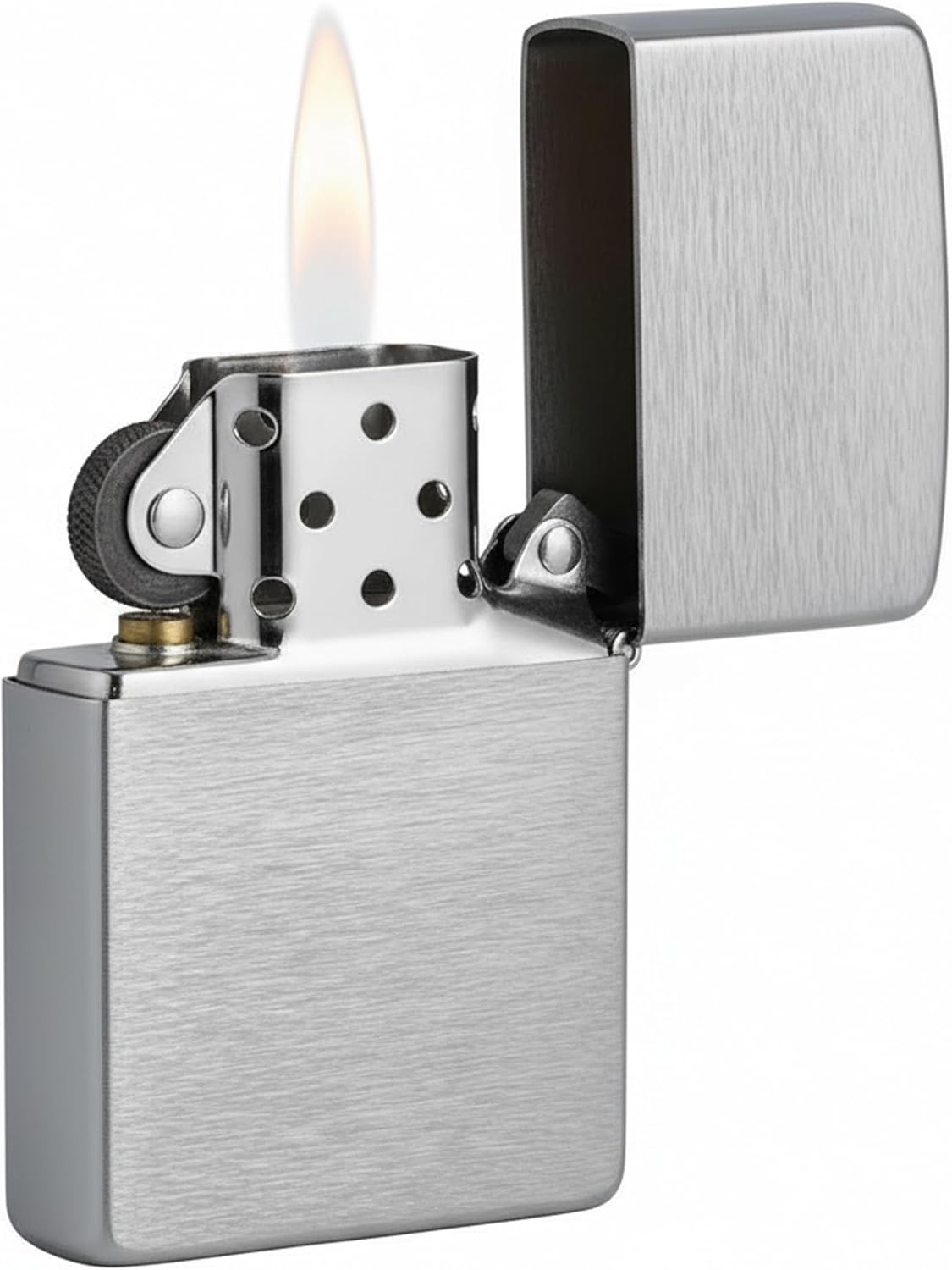
Zippo will fix this lighter for the rest of your life. Break the hinge, wear out the cam, snap the spring — send it to Bradford, Pennsylvania and it comes back working, free, with no receipt and no warranty card. That promise is ninety-four years old and it is the whole reason the object exists in the form it does. But read Zippo’s own troubleshooting pages and you find the line that nobody quotes: the finish and the decoration are not covered. So the mechanism is guaranteed forever and the surface — the brushed chrome you actually chose, the part you look at every day — is guaranteed for nothing. That is not a scandal. It is the most useful single fact about buying one, and it tells you exactly which Zippo to buy.
We verify manufacturing against primary sources, read what actual owners report, and never accept payment for rankings.
Which one is this, exactly?
Zippo’s catalogue runs to well over a thousand lighters and almost all of them are the same lighter wearing something different. This review covers the plain one.
Zippo calls it Classic Brushed Chrome and it is item 200 — the part number that has identified this finish for decades and still appears on the maker’s own product page today, inside the full store SKU 200-017296. Retail listings sometimes surface a longer internal model number alongside it; the number that matters, the one Zippo itself uses, is 200.
The finish is a horizontal brushing across the front and back of the case, with the two narrow sides buffed to a high polish so they catch light against the matte faces. Zippo dates the finish to 1933 and describes it as its most popular lighter, which is a claim about the whole ninety-four-year run rather than this quarter’s sales chart.
Three neighbours are easy to buy by mistake. Item 250 is High Polish Chrome — identical case, mirror finish everywhere, and it shows fingerprints and hairline scratches in a way the brushed one does not. Item 218 is Black Matte, a painted finish that looks superb and is the one most exposed by the finish exclusion described below. And the Slim® case is a genuinely different, narrower body; Zippo sells a Slim Brushed Chrome that photographs almost identically to this one at thumbnail size. Several owners of the Classic report that the lighter they received felt smaller than the Zippo they remember, and the Slim is the usual explanation. If you want the full-size lighter, you want 200.
What it is actually like to own
The mechanism has three moving parts worth naming: a hinged lid that closes on a cam and spring, which is where the sound comes from; a flint wheel that throws sparks into a cotton wick; and an insert that lifts straight out of the case, carrying the fuel chamber, the packing, the felt pad and the flint tube. Nothing is glued, nothing is sealed, and every consumable is replaceable with a coin and a pair of tweezers. That is not nostalgia — it is the reason a lifetime repair guarantee is economically survivable for the company offering it.
The windproof claim is precise and worth stating precisely, because owners argue about it. The chimney — the perforated metal shroud around the wick, lifted directly from the Austrian lighter George Blaisdell was trying to improve on in 1932 — keeps a moving flame alive in wind that would kill a butane torch or a disposable. It does not make the flame invisible to wind. Cup it or turn your back and it stays lit in conditions that would defeat almost anything else in your pocket. Hold it out flat in a gust with a wick that needs trimming and it will go out, and the owner who does that will tell you the lighter is not windproof at all.
The habit you have to learn is fuel. Zippo lighter fluid is a volatile naphtha that evaporates through the packing whether or not you use the lighter. A Zippo left in a drawer for a month is a dry Zippo. Owners who use one daily refill roughly weekly and think nothing of it. Owners who bought one as a keepsake reach for it in an emergency and get sparks and no flame, and reasonably conclude the thing is broken. It is not broken. It is a wick lighter, and this is what wick lighters have always done.
The guarantee, and the hole in it
Zippo’s own knowledge base is unusually direct about all of this, which we credit it for. Three pages there decide most of what a buyer needs to know.
On a broken hinge, Zippo writes: “After lots of use, the hinge on your Zippo lighter can detach from the lid or bottom of the case. The good news is that this is easily fixed and we will fix it for free thanks to our lifetime warranty!” No qualifier, no age limit, no proof of purchase. The repair clinic that does this work sits inside the Zippo/Case Museum in Bradford, where visitors can watch it happen.
On the finish, Zippo writes: “The finish and decoration on a Zippo Windproof Lighter are not covered by the lifetime guarantee.” If it is under a year old you are invited to contact them to discuss options; beyond that, wear is yours. Nobody hides this, but nobody puts it on the box either.
Those two sentences together are the buying advice. The guarantee protects the machine, not the jewellery. A brushed chrome case ages by acquiring a scuffed, hand-worn patina that most owners come to like, because there is no coating to fail — the brushing is the surface. A painted or printed lighter ages by chipping, and chipping is explicitly on you. If you want a Zippo that looks better after five years in a pocket rather than worse, the plain brushed one is the correct choice and it is also the cheapest way into the line. That is a rare alignment.
On a lighter that will not light, Zippo leads with: “This may sound silly, but Zippo lighters don’t come with fuel in them.” It then walks through a stuck flint wheel, a carbonised wick that needs pulling and trimming once or twice a year, and wick replacement after two or three trims. All of it is honest and all of it is work. This is a maintained object.
What owners actually say
The pool is deep — 16,501 ratings at 4.5 stars — and its shape is more interesting than its average. Seventy-seven percent are five stars and ten percent four, which is ordinary. Six percent are one star, which is not. A one-star tail three times the size of the two-star band is the signature of a product that either arrives working or arrives useless, with little middle ground, and reading the critical reviews confirms it.
The most common complaint is not a fault at all: it ships empty. Buyers open the box, flick the wheel, get a spark and nothing else. Zippo says this plainly on its own site and the packaging says it too, but it lands as a surprise often enough that it dominates the three-star reviews. One buyer, denied a flame, describes the experience as being sold a lighter that needs more money spent on it before it lights. He is not wrong about the sequence of events. This is a quirk of the category, not a defect, and it belongs in your expectations rather than in a return.
The one genuine defect is a lighter that will not light reliably after correct service, and it is real. The most detailed critical review in the pool comes from an owner who says he has owned dozens of Zippos and knows how to service them: he went through five flints and two wicks with genuine Zippo fuel and still could not get his to light dependably, then contacted Zippo and got no answer within a week. Another owner reports the lid breaking off one lighter and the hinge failing on a second, and rates the brand’s quality as not what it was. Treat both as defects and use the guarantee — the repair form is free to file and the hinge failure in particular is the exact case Zippo says it fixes at no charge. Do not accept a dud because the average is high.
Missing flint is a smaller but distinct failure. At least one owner found no flint installed at all and had to improvise one before the lighter would spark. That is a factory omission rather than a design choice, and it is worth checking on day one alongside the fuel.
Fuel consumption is the complaint that spans the whole rating range, which is what makes it credible. A five-star reviewer who calls the lighter “Ol’ Reliable” opens by noting it runs out of oil fast. A two-star reviewer says his goes bone dry in about two days where his other Zippos last five to eight. Somewhere between those two is a real variable — how full the packing was saturated, how well the lid seats, ambient heat — but the direction is unanimous and it is not going to change. Another owner reports the flint wheel sticking after extended use and having to roll it up before rolling it down, which is precisely the debris problem Zippo’s own troubleshooting page tells you how to clear.
Two more themes deserve naming. Fuel availability frustrates people: several report having to order genuine fluid online, and one warns that generic naphtha jams the lighter faster and burns through quicker. And a handful of buyers argue the lighter has shrunk since they last owned one — almost certainly the Slim case confusion described above, but it recurs often enough to be worth a sentence.
The praise is unusually flat, and that is a compliment. Most five-star reviews say some version of “it’s a Zippo, which means it is well-made and reliable,” and stop. There is no enthusiasm about features, because there are no features. What is absent from a pool of sixteen thousand is more telling: no pattern of cases cracking, no reports of the brushed finish flaking, no burns from the object itself in normal use, and no complaint that the repair service refused a job. For a mechanical product this old, sold this cheaply, that is a clean record.
Made in USA Verification
- Zippo states the origin of this specific item, on its own product page, in its own feature list: “Made in USA; Lifetime guarantee that ‘it works or we fix it free’.” That sentence sits on the Classic Brushed Chrome page at zippo.com, attached to SKU 200-017296.
- The claim is unqualified. No “with globally sourced components,” no “assembled in,” no “of domestic and imported materials.” Zippo writes Made in USA and stops. We tier it exactly as written: Made in USA.
- The plant is named, singular, and has not moved. Zippo’s own history places the company’s founding at Bradford, Pennsylvania in 1932 and it has manufactured there ever since. The repair clinic where warranty work is performed is in the same town, inside the Zippo/Case Museum, and is open to visitors.
- The scale is documented by the maker. Zippo records that during its eightieth anniversary year in 2012, production surpassed the five hundred millionth lighter. Every one of those carries a date code stamped into the base — a practice Zippo says began in the mid-1950s for quality control and is now used by collectors to date individual lighters.
- Ownership has stayed in the family. Zippo lists George B. Duke, founder George Blaisdell’s grandson, as Chairman, and his son Grant B. Duke as President and CEO.
- What we did not accept. The Zippo name on a box is not by itself an American-made signal. Zippo’s own site describes a product line that now includes butane multi-purpose lighters, fragrances, eyewear, lifestyle accessories and outdoor gear, and it acquired the Ronson lighter and fuel brands in 2010. Our brand guide is blunt about the consequence: the metal windproof lighter is made in Bradford, while a number of Zippo’s non-lighter products are sourced overseas and have to be checked individually. This verification covers item 200 and does not transfer to the next thing with a Zippo logo on it.
- A note on the sister company. Zippo bought W.R. Case & Sons Cutlery in 1993 and Case knives are made in the same town. That is a genuine second American manufacturer under one roof, not a licensing arrangement — and we have reviewed one of its knives separately rather than folding it into this verification.
Specifications
| Item number | 200 (full store SKU 200-017296) |
| Name | Classic Brushed Chrome — Zippo Windproof Lighter |
| Finish | Horizontal brushing front and reverse; sides buffed to high polish |
| Finish introduced | 1933 |
| Case | All metal, hinged lid, Classic (full-size) body |
| Ignition | Flint wheel and cotton wick; chimney-shielded flame |
| Fuel | Zippo lighter fluid, sold separately — the lighter ships unfuelled |
| Serviceable parts | Flint, wick, felt pad, packing material, flint screw — all user-replaceable |
| Maintenance | Pull and trim the wick once or twice a year; replace after two or three trims (Zippo) |
| Guarantee | Lifetime, “it works or we fix it free” — mechanical only |
| Guarantee exclusion | “The finish and decoration… are not covered by the lifetime guarantee” (Zippo) |
| Packaging | Gift box |
| Date code | Stamped into the base of every windproof lighter since the mid-1950s |
| Manufacturing | Bradford, Pennsylvania |
| Origin | “Made in USA” — unqualified, on Zippo’s own product page |
| Company founded | 1932, Bradford, Pennsylvania; still family-owned |
| Owner rating | 4.5 out of 5 — 16,501 ratings (77% five-star, 10% four-star, 5% three-star, 2% two-star, 6% one-star) |
How it compares
Against a disposable butane lighter, this is not a close contest on any axis except one. The disposable lights instantly, never needs refilling, and costs almost nothing — and then it is landfill, and it was made overseas, and it will fail in wind that this lighter shrugs off. The Zippo asks you to buy fuel, learn a maintenance routine and accept that it will be dry if you neglect it. In exchange it is repairable forever by the company that built it, in the town where it was built.
Against a butane torch lighter, the trade is different. A torch produces a hotter, directed flame that is better for pipes, cigars and stubborn wicks, and it does not evaporate in a drawer. It is also, in most cases, made in Asia, sealed against user repair, and finished when the piezo igniter dies. Zippo itself sells butane inserts that drop into this same case, which is a reasonable middle path — and worth knowing that the insert, not the case, is the part that changes.
Inside Zippo’s own line, the honest comparison is against the decorated lighters, which is where most of the catalogue and most of the marketing lives. A printed, engraved or coloured Zippo is the same machine in a costume, and the costume is the one component the lifetime guarantee explicitly will not replace. Brushed chrome is the finish with the least to lose. It is also the finish that looks most like the lighter people picture when they hear the word.
Related guide
Buying Guide
The Best American-Made Grilling & Outdoor Fire Gear
Four verified picks for fire starting, charcoal grilling, fixing uneven heat, and cooking over coals.
Related reviews
Pros & Cons
Pros: An unqualified “Made in USA” on Zippo’s own product page for this exact item, with no globally-sourced hedge attached; a single named plant in Bradford, Pennsylvania that the company has never left since 1932, and a repair clinic in the same town you can walk into and watch; a lifetime mechanical guarantee that Zippo states in writing covers a detached hinge free of charge, with no receipt and no registration; a fully user-serviceable design in which flint, wick, felt, packing and flint screw are all replaceable with a coin and tweezers, which is why the guarantee is sustainable rather than a slogan; a chimney design that keeps a flame alive in wind that kills butane; a brushed finish that wears into a patina rather than chipping, making it the smartest choice in a catalogue where finish is the one uncovered component; a date code stamped into every base since the mid-1950s; five hundred million lighters produced by the company’s own count as of 2012; still owned by the founder’s grandson and great-grandson; and an owner pool of 16,501 ratings deep enough that the absence of structural-failure reports carries real weight.
Cons: It ships with no fuel and, in at least some cases, no flint installed — which is the single largest source of disappointed reviews and means it is not a gift that works the moment it is unwrapped; the fluid evaporates whether you use it or not, so a lighter kept for emergencies is a lighter that will be dry in the emergency, and owners report anything from a couple of days to a week per fill; the finish and decoration are explicitly excluded from the lifetime guarantee, which quietly undercuts the entire decorated side of the range; a six percent one-star rate that is triple the two-star rate, consistent with a small but real population of units that never work properly, including one experienced owner who replaced five flints and two wicks without fixing his; scattered reports of lids and hinges failing and of a flint wheel that sticks with debris; genuine Zippo fuel is awkward to find in shops and generic naphtha is reported to foul the lighter faster; the wick needs pulling and trimming once or twice a year and replacing after two or three trims, which is maintenance most buyers will not expect; the flame is windproof, not wind-invisible, and owners who expect the latter say so loudly; the Slim case is easy to buy by accident and is a different, narrower lighter; and Zippo’s American-made record covers the metal windproof lighter specifically, not the fragrances, eyewear, butane products and outdoor gear that now share the name.
Should You Buy It?
Yes — with one caveat.
Buy it if you want one pocket object that you will never have to replace and that was made, and is still repaired, in the same Pennsylvania town it came from in 1932. The origin evidence here is about as clean as this category offers: an unqualified Made in USA statement from Zippo on the page for this exact item, one named plant, a repair clinic you can visit, and a family still holding the company. Buy the brushed chrome specifically rather than a printed or coloured one — Zippo’s guarantee covers the mechanism for life and excludes the finish in writing, and brushed chrome is the finish with nothing to chip. The caveat is that this is a maintained object, not an appliance: it arrives empty, it needs fuel you will have to order, it goes dry in a drawer in about a month, and its wick wants trimming once or twice a year. If that sounds like a chore rather than a ritual, buy a butane lighter and be happier. And if yours will not light reliably after a fresh flint, a fresh wick and genuine fuel, do not shrug and put it away — that is the defect a small share of this pool reports, and it is exactly what the free repair form exists for.
The exact model we reviewed — the Zippo Classic Brushed Chrome Windproof Lighter, item 200 — is stocked at the Buy American Store.
Buy the Zippo Classic Brushed Chrome Lighter at the Buy American Store
Item 200, the full-size Classic case. The Slim® Brushed Chrome is a narrower body, and item 250 High Polish Chrome is the mirror-finish version of the same lighter. Fuel and flints are sold separately.
Ninety-Four Years in Bradford
How a lighter designed at a Pennsylvania country club in 1932 became one of the most recognisable American-made objects in the world — what Zippo still makes in Bradford, which parts of its line are sourced overseas, and how the lifetime guarantee actually works.