Editorial disclosure: We independently research and review products.
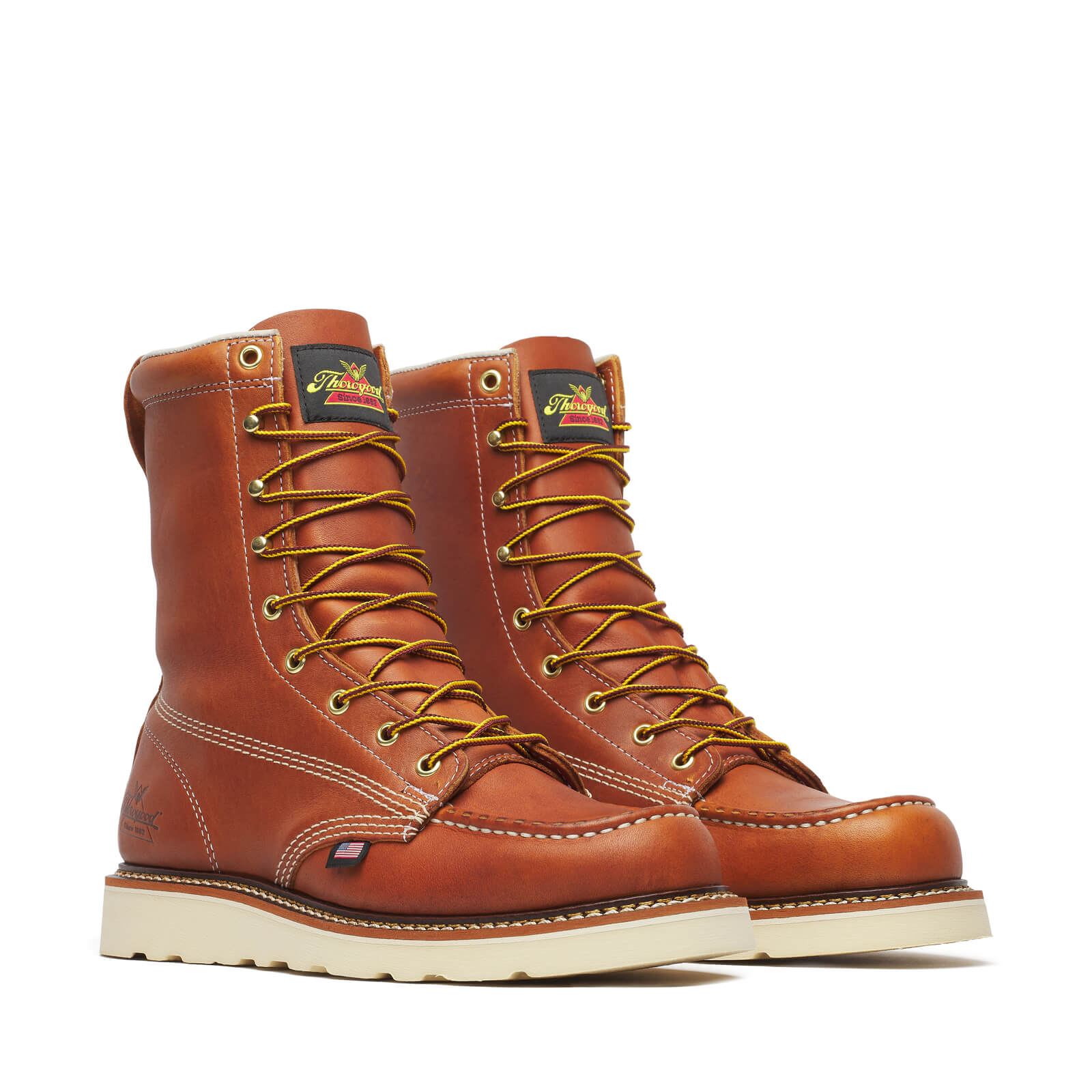 Thorogood 814-4201
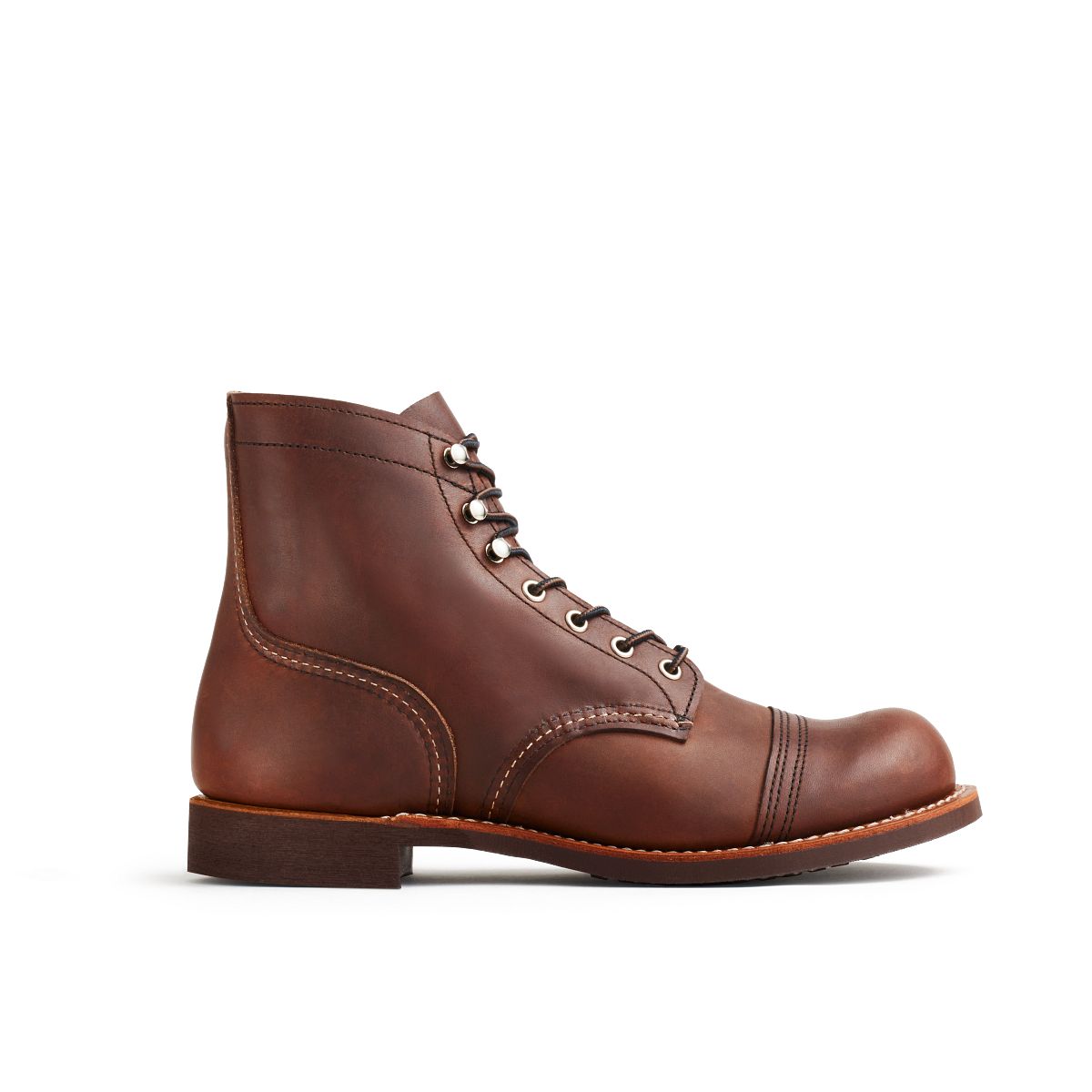 Red Wing Iron Ranger 8111
Two American bootmakers, two honest answers to the origin question, and two boots that are almost nothing alike underfoot. Thorogood puts a qualified label on the American Heritage 8″ Tobacco Moc Toe, style 814-4201, and then explains in writing why the qualifier is there. Red Wing puts an unqualified one on the Iron Ranger, Heritage #8111, and backs it by handing worse labels to its own work boots. Both companies are telling the truth.
Which means the origin badge, for once, is not the thing that decides this. The sole is. So is the last, so is the first month of ownership, and so is what you are standing on all day.
The scoreboard
Thorogood American Heritage 8″ Moc Toe (814-4201)
Made in USA with globally sourced components
Final construction in Weinbrenner’s union factories in Wisconsin. Owner rating 4.4 / 5 across 2,553 ratings. Comfortable from the first hour, superb on concrete, rebuildable when the wedge wears out — and held back by a thin footbed and a one-year warranty.
Red Wing Iron Ranger, Heritage #8111
Made in USA
Built in Red Wing, Minnesota on leather from a tannery the company owns. Owner rating 4.5 / 5 across 1,860 ratings. A decade-long boot with a Vibram mini-lug and a steel shank — if you survive the break-in and get the width right.
Side by side
| Thorogood 814-4201 | Red Wing #8111 | |
|---|---|---|
| Model | American Heritage 8″ Tobacco Moc Toe – MAXWear Wedge™ | Iron Ranger® 6-Inch Boot, Amber Harness |
| Style number | 814-4201 (the 6-inch is 814-4200, a different style) | Heritage #8111 (black #8084, Alpine Portage #8078, wedge-soled #8088, women’s #3365) |
| Our origin tier | Qualified — the maker’s own wording | Made in USA — unqualified badge on the product page |
| Where it’s built | Weinbrenner Shoe Company, Wisconsin, union factories, employee-owned, since 1892 | Red Wing, Minnesota since 1905; also Potosi, Missouri and Clarksville, Arkansas |
| Leather | Tobacco oil-tanned full-grain, unlined | Amber Harness full-grain, oiled, tanned in-house at S.B. Foot Tanning Company |
| Construction | Goodyear storm welt — resoleable | Goodyear leather welt — resoleable through Red Wing’s own repair service |
| Outsole | MAXWear Wedge™ polyurethane slab, no lugs | Vibram® 430 mini-lug (older production used a nitrile cork sole under the same number) |
| Shank | Composite | Steel |
| Toe | Soft moc toe, roomy box | Cap toe on the No. 8 last, bump toe |
| Break-in | Essentially none — soft from day one | Two weeks to three months, and genuinely unpleasant |
| Sizes and widths | 7–14 in D and EE | 4.5–14 in D and EE |
| Safety rating | None — soft toe | None — Red Wing states Heritage boots do not meet modern jobsite requirements |
| Warranty | One year against defects; normal sole wear excluded; authorized sellers only | Manufacturer repair service rather than a headline warranty term |
| Owner rating | 4.4 / 5 (2,553 ratings) | 4.5 / 5 (1,860 ratings); 4.4 from 992 on Red Wing’s own site |
| Our score | 4.0 / 5 | 4.6 / 5 |
The sole is the whole decision
Everything else in this comparison is a detail. This is not.
The Thorogood rides on the MAXWear Wedge: one flat slab of polyurethane with no lugs and no heel break. On concrete, shop floors, roof decks and ladder-to-flat-work, that slab is the entire appeal. There is no heel edge to roll off, the contact patch is enormous, and the compound is soft enough that the boot feels broken in the first time you lace it. Thorogood markets these as needing no break-in and, unusually, the marketing matches what owners report.
Take that same sole off flat ground and it becomes a liability. A wedge has nothing to bite mud, gravel, snow or a wet slope with, and it packs up fast. Thorogood knows this — it sells lug-soled versions of the same boot for exactly that reason.
The Iron Ranger runs a Vibram 430 mini-lug over a steel shank. It grips uneven, wet and loose ground the way the wedge cannot, and the steel shank gives it a spine the composite-shanked Thorogood does not have. The cost is paid standing still: a lug sole on concrete for ten hours is less forgiving than a wedge, which is precisely why Red Wing’s own answer to the Thorogood — the Classic Moc #875 — uses a wedge instead.
So the first question is not which brand you trust. It is whether the ground under you is flat.
Comfort now, or comfort later
The Thorogood asks almost nothing of you on day one and a little every day after. It is soft immediately, the moc pattern gives an unusually roomy toe box, and wide-footed people tend to land here for that reason. What it does not give you is support: the stock footbed is thin and the wedge offers essentially no arch, and a real share of owners end up buying an aftermarket insole to get through a shift. Plan on it.
The Iron Ranger inverts that completely. The leather arrives stiff, the insole is flat and hard until it packs out, and the first weeks are an argument — anywhere from two weeks to three months depending on how hard you wear them. What you get on the other side is a leather insole over a cork midsole that has moulded to your actual foot, which is a better end state than any insole you can buy.
Then there is sizing, and on the Red Wing it is the whole purchase. The No. 8 last runs long and, for a lot of feet, narrow, and it does not behave like any sneaker size you know. The characteristic failure is getting the length right and the width wrong. Get measured on a Brannock device before you order, treat EE as a normal option rather than a special request, and if you are caught between, go for the width. The Thorogood has its own version of this problem, milder: its EE runs closer to a generous D and gains room in the ball of the foot rather than the toe box, so the roomy reputation comes from the toe shape, not from extra width.
How each one earns its badge
These two boots carry different tiers on this site, and it is worth being precise about what that does and does not mean.
Thorogood publishes the qualifier itself. The 814-4201 product page carries the spec line “Made in USA with USA and globally sourced components,” and the About page explains it rather than hiding it: the company sources most components domestically, including its leather hides, but uses global materials in some instances, which is why the qualified label exists. Final construction, it says, “is always completed in our Union factories in Wisconsin.” Companies dodging this question do not write paragraphs like that.
Red Wing publishes a grading scheme and then applies it against itself. It defines four origin labels in writing, and the Iron Ranger carries the top one: built start to finish in the USA using American labor and, in Red Wing’s own words, over 95% USA-made materials. The proof that the scheme is real is not the badge — it is the demotions. On the day the review was written, all twenty-six badges on the men’s Heritage catalog read “Made in USA,” while the men’s Work catalog returned six boots labelled “Assembled in USA w/ Imported Components,” plus two further qualified wordings. A company willing to hand its own work boots a lesser label is a company whose top label means something. Red Wing also owns the tannery — S.B. Foot, in the same town as the factory — which is vertical integration on the single most expensive input in a boot.
What the tier gap does not mean: that Thorogood is hiding something, or that the Iron Ranger is the more American boot in some absolute sense. One company discloses a qualifier; the other clears a bar it set and published. Both build in American factories they are willing to name. And note what Red Wing does not claim: its own top-tier definition says “over 95%” USA-made materials, with the remainder unitemised, and the company states plainly that it makes boots elsewhere too. The badge belongs to the style, not the brand — check the number on the box.
What owners actually complain about
Neither boot has a reputation for falling apart, so the complaints are about fit, comfort and terms — which is exactly where a boot purchase actually goes wrong.
Thorogood. The wedge is not universally comfortable, and this is not a fringe view — multiple owners report their feet hurting before an eight-hour shift is out, with the thin stock footbed and absent arch support named as the cause. The EE is not as wide as the reputation suggests. Stitching quality is not perfectly consistent: owners describe uneven or missed stitches where the toe meets the sole, and the rarer but real case of a mismatched pair where one boot ran smaller than the other. And the terms are tight — one year against defects, normal sole wear explicitly excluded, authorized sellers only, with returns required unworn on a product you cannot evaluate without wearing it. That warranty is the single biggest mark against it on our scorecard.
Red Wing. Sizing dominates, by a distance, and owners genuinely disagree about whether the boot runs true or long because they are describing the same last from different feet. Break-in stiffness converts into one-star reviews from buyers who were not warned. Owners rate value well below quality on Red Wing’s own site — the widest gap in the company’s data for this boot, and a fair summary of the objection: excellent boot, costs a lot. The one-star share sits at six percent against one percent two-star, which is the signature of a purchase that either works or does not on arrival rather than one that wears out badly. And one style number has covered two different outsoles over the years, so an older nitrile cork sole can still turn up where you expected the Vibram — check what arrives. Finally, it is not waterproof, not insulated and not safety-rated, which Red Wing says plainly and buyers still miss.
Who should buy which
Buy the Thorogood 814-4201 if you work on flat ground. Concrete, shop floors, decks, ladders. Buy it if you want an American-made boot you can wear home the day it arrives and have resoled instead of replaced, if you have a wide forefoot that the moc toe box will finally accommodate, and if you are willing to swap the footbed when your arches object. Do not buy it for mud, gravel, snow or slopes, and do not buy it expecting warranty coverage to match the heirloom marketing.
Buy the Red Wing Iron Ranger 8111 if you want one pair for the next decade and your ground is uneven, wet or loose. Buy it if you can get measured properly before ordering, if you want a cap toe and a steel shank that take abuse, and if you can serve the break-in sentence without deciding at week two that you have made a mistake. Do not buy it if you need to be comfortable this month, and do not buy it by eye from a photograph — the sizing is the only thing that ruins this purchase.
The tradeoff, named plainly: you are trading day-one comfort and a forgiving fit for grip on bad ground and a boot that outlasts several soles. You are trading in one direction or the other, because neither boot does both. The Thorogood is easier to own and the Iron Ranger is better built, and the higher score here reflects the second thing, not a recommendation that everyone buy it.
And a caveat that applies to both: neither of these is a safety boot. The Thorogood 814-4201 is a soft toe, and Red Wing states outright that Heritage boots do not meet modern jobsite safety requirements. If your site requires a protective toe, both companies make one — neither of these is it.
Shop the winners
The American Heritage 8″ Tobacco Moc Toe, style 814-4201 — the exact model we scored 4.0 / 5, wedge sole and all.
The Iron Ranger, Heritage #8111 in Amber Harness — the exact model we scored 4.6 / 5, on the Vibram 430 mini-lug.
Shop the Red Wing Iron Ranger 8111 in the Buy American Store →
Read the full reviews
Learn more about the companies
Who actually makes these boots, why one origin label carries a qualifier and the other does not, and which lines each badge does not cover: read the Thorogood brand guide and the Red Wing brand guide.