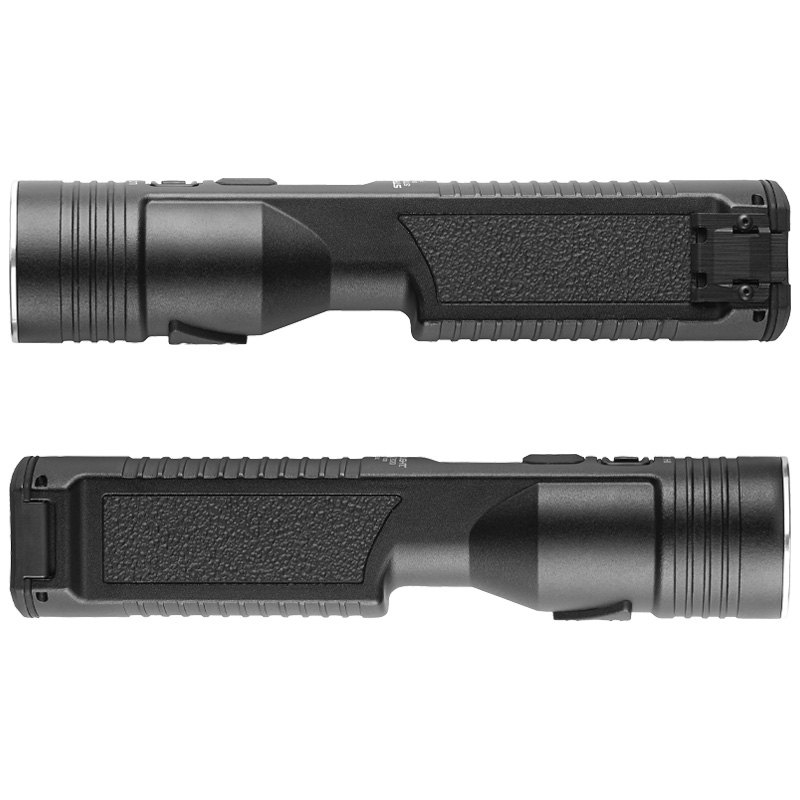
Streamlight does not put an origin badge on its product pages. It does not answer the question in its FAQ, it has no Made-in-USA page, and the word “manufacturing” on its About page describes the company rather than any particular light. For a week that would look like a dead end. It is not. Streamlight publishes a one-page fact sheet for every product it sells, and in the top-right corner of every one of those sheets, in small type beside the revision date, it prints where that model is made. Go and read them and the Stinger family splits in two.
We verify manufacturing against primary sources, read what actual owners report, and never accept payment for rankings.
Which one is this, exactly?
“A Stinger” is not a flashlight. It is a fifty-year-old product line with fifteen current members, and several of them share a silhouette, a charger and most of a name while being different lights built in different countries. The number on the carton is the only thing that settles it.
This review is of the Stinger® 2020, the 2,000-lumen light with the slide-action mode selector, in the configuration Streamlight lists as item 78101. Streamlight’s own part-number sheet defines it precisely:
- 78101 — Stinger 2020, 120V AC/12V DC, 1 Holder, Black. The one reviewed here. UPC 080926-78101-6. It is the version that arrives with a charging cradle and both a wall cord and a vehicle cord.
- 78100 — Stinger 2020, Light Only, Black. Same flashlight, no cradle; ships with a “Y” USB cord instead. If you already own Stinger chargers, this is the one you want.
- 78121 / 78131 — the same AC/DC package in red and blue. 78120 / 78130 are the light-only versions in those colours.
- 78102, 78103, 78104 — 230V, 240V and 12V-DC-only variants for markets and vehicles outside the standard US package.
And three near-relatives that are not this light at all. The Stinger® 2020 S is a separate current product with its own part numbers and its own documentation. The Stinger LED HL® and Stinger DS LED HL® are the older 800-lumen NiMH lights — longer, heavier, a different switch layout and, as the next section shows, a different country. The UltraStinger® LED is the big 1,100-lumen thrower. If you are shopping by photograph you will mix these up, because Streamlight has been iterating on the same anodized tube since the Carter administration.
Where Streamlight actually writes the country down
This is the part that took the work, and it is the reason this review exists.
We checked, on Streamlight’s live site, the places an origin claim normally lives. The Stinger 2020 product page carries no origin statement of any kind. Neither does the Stinger DS LED HL page. The FAQ section has forty-odd questions across Service, General, Batteries, Chargers and Product Specific, and not one of them is “where are your flashlights made?” There is no Made-in-USA page. The About Us page says the company “has designed, manufactured and marketed” flashlights for fifty years and that it is “based in Eagleville, PA, with our headquarters and manufacturing plant serving as a central hub to our worldwide operations” — a statement about the company, not about any light you can buy. Its Cornerstones page names the four things the business is built on: Engineering, Materials Management, Assembly, and Sales & Marketing. Streamlight describes itself, in its own words, as a company that engineers and assembles. It does not describe itself as one that fabricates everything it sells.
The answer is in the documentation tab. Every Streamlight product page links a one-page PDF fact sheet, and every fact sheet carries a single line of small print at the top: issue date, revision date, revision number, origin, document number. That line is where Streamlight tells you the country. Here is what the Stinger fact sheets say, read on 18 September 2026:
| Fact sheet | Models it covers | Origin line, verbatim |
| Document #355 (Rev 3, revised 14 Aug 2024) | Stinger® 2020 — the light reviewed here | “Assembled in the USA.” |
| Document #229 (Rev 1, revised 29 Jan 2018) | Stinger® Classic LED | “Assembled In The USA.” |
| Document #201 (Rev 11, revised 8 May 2019) | Stinger® LED, Stinger DS® LED | “Engineered in the USA, manufactured in China” |
| Document #226 (Rev 2, revised 8 May 2019) | Stinger LED HL®, Stinger DS LED HL® | “Engineered in the USA, manufactured in China” |
| Document #231 (Rev 3, revised 8 May 2019) | UltraStinger® LED | “Engineered in the USA, manufactured in China” |
Five sheets, one product family, two countries. The company is not hiding it — it is printed on the document the product page links to — but it is also not on the page anyone actually reads, and the two groups look identical in a listing photograph.
Which is why the badge on this review says what it says. Streamlight’s wording for the Stinger 2020 is “Assembled in the USA,” and that is the tier we have given it: not the unqualified top badge, which the company does not claim, and not a downgrade either, because the company does claim American assembly in writing, for this model, on a sheet it revised in 2024. The same sheet also records that the light is Trade Agreement Act-compliant, a US federal procurement standard the China-built Stingers could not meet. Streamlight does not publish a component-by-component breakdown, so we do not claim one. The honest summary is: put together in Eagleville, Pennsylvania, from parts whose individual origins the company has not disclosed.
If you are buying a Stinger specifically because it is American, nothing else on the box tells you. The most-reviewed Stinger on the open market by a wide margin is the Stinger DS LED HL, item 75458, which carries several thousand owner ratings and an excellent score — and whose fact sheet, Document #226, says it is manufactured in China. It is a good flashlight. It is not an American one, and nothing on its product page tells you that.
The mode switch is the whole design argument
Every Stinger before this one changed brightness the same way: press and hold the head button and cycle through high, medium and low, in order, every time, and hope you stop on the right one. The Stinger 2020 replaces that with a small three-position slide switch on the shoulder of the head, marked LO MED HI. You set it and leave it. Tap either button and the light comes on at the level you chose.
Owners who came from an older Stinger are almost unanimous that this is the right idea. One long-time owner, describing the change from a decade-old Stinger LED, put it as not having to hold a button down to get where he was going — just slide it. On a duty light, where the difference between 100 lumens and 2,000 lumens is the difference between reading a document and blinding yourself off a white wall, being able to pre-select matters.
It is also the single most-criticised part of the light. The switch sits nearly flush with the body — deliberately, so it cannot snag — and flush means very little to grip. Owners describe it as feeling cheap relative to the rest of the flashlight, as moving too easily in a pocket, and as needing more purchase than it offers with gloves on. One search-and-rescue user reported that after a single field callout, four days after his light arrived, grit had worked into the selector and cycling it became stiff and slow; he wanted the switch to stand a hair proud of the body for leverage. The two push-buttons draw a related complaint: several owners call them squishy, and say it is easy to press one far enough to feel it but not far enough to actuate it.
None of that is a reason not to buy the light. It is a reason to know that the part of the design that makes the Stinger 2020 better than every Stinger before it is also the part most likely to annoy you, and — see the warranty section — the part with the shortest coverage.
What it is actually like to own
The numbers, all from Streamlight’s published figures rather than a listing: 2,000 lumens and 25,000 candela on high with a 315-metre beam, 850 lumens and 200 metres on medium, 100 lumens and 70 metres on low, plus a strobe. The body is anodized aluminium alloy with rubberised grip panels; the lens is shock-mounted BOROFLOAT® glass rather than the polycarbonate used on the older Stingers. It is 7.67 inches long and 12.3 ounces with batteries — which is to say, shorter and lighter than a Stinger DS LED HL while producing well over twice the light.
Read the run times carefully, because they do not mean what they look like. Streamlight rates the light at two hours on high, and states on the same sheet that all run-time claims are measured to 10% of initial lumen output, per the ANSI/PLATO FL1 standard. That is not two hours at 2,000 lumens. It is two hours until output has fallen to about 200. Every honest flashlight manufacturer publishes to this standard and almost no buyer reads the footnote; Streamlight prints it, so we are repeating it.
Power is two SL-B26® protected lithium-ion packs, 2,600 mAh each, which charge in the light, in the cradle, or off a USB cord — a genuine convenience, and the reason this light does not need to live on a charger. One trade-off worth naming: Streamlight rates the SL-B26 at 500 charge cycles. The NiMH pack in the older Stingers is rated at 1,000. You get lithium-ion’s weight, voltage and self-discharge behaviour, and you give up half the rated cycle life.
The light is IPX7 — waterproof to one metre of submersion, not a dive light — and tested to two metres of impact resistance, which is a step up from the one metre the older Stingers claim. Each light is serialized, which matters for departments that inventory equipment.
The warranty covers the body for life and the switch for two years
Streamlight’s Limited Lifetime Warranty is one of the reasons the brand has the loyalty it has, and the page is worth reading in full rather than trusting the headline. The company warrants its products free of defects “for a lifetime of use except for batteries and bulbs, abuse and normal wear” — and then, in the same paragraph: “This limited lifetime warranty also excludes rechargeable batteries, chargers, switches and electronics which have a 2 year warranty with proof of purchase.”
Line that up against what this particular flashlight is. The Stinger 2020 is a rechargeable light whose defining feature is a switch, which arrives with a charger and two battery packs. The aluminium tube is covered for life. The mode selector, the two push-buttons, the electronics, the cradle and the SL-B26 packs are covered for two years. That is not a trick and it is not unusual for the category — almost nobody warrants a lithium pack for life — but it does mean the lifetime warranty covers the part least likely to fail and not the part owners complain about most. Keep the proof of purchase.
What owners actually say
The pool behind the store listing is 4.7 out of 5 from 1,310 ratings — 88% five-star, 7% four, 2% three, 1% two, 2% one. That is a deep pool by this site’s standards and an unusually top-heavy one, and it means the critical reviews are a small population that has to be read individually rather than summarised.
We will say plainly what we found: the criticism of this flashlight is thin, and it is almost entirely about ergonomics rather than failure. Among the critical reviews we read there was no cluster of dead lights, no pattern of water ingress, no reports of the body failing. What there is sorts into five piles.
The selector switch, which we have already covered. It is the most-repeated complaint by a distance, and it comes from owners who otherwise like the light very much. Typical framing: the construction is rugged, the grip is excellent, the battery-door clip is superb, and then — the low/medium/high toggle feels like it belongs on a cheaper flashlight. Treat this as a normal quirk of the design, not a defect, unless yours seizes; a selector that has stopped cycling is a warranty claim inside the two-year window.
Beam tint. Several owners report a warm, yellowish cast with a slightly cooler spot in the middle, and at least one says his 800-lumen Stinger HL throws a visibly whiter light despite being less than half as bright. Streamlight publishes lumens, candela and beam distance for this light but no colour temperature and no CRI figure, so there is nothing on paper to check the complaint against. If neutral-to-cool tint matters to you, that is a real unknown going in.
The anti-roll design does not fully deliver. Streamlight markets the body shape as anti-roll, and more than one owner has taken the trouble to say that it rolls anyway on anything sloped unless you set it down gently — and that they cannot get it to prop where they want it while working. The contoured body slows a roll; it does not stop one.
It is a big light for its output. The comparison owners keep making is against modern single-cell 21700 lights that hit comparable numbers in a much smaller package. That is fair. The Stinger 2020 is a duty-light form factor, designed to fit fifty years of existing Stinger chargers and cradles. Compatibility is the reason for the size, and if you are not inheriting a drawer full of Stinger chargers you may not want to pay for it in bulk.
Fit and finish, occasionally. Isolated reports of a grip panel lifting at the edge out of the box, and one owner whose light would not take a charge at all — the charger simply flashed red and never completed. Those two are different animals from the rest of the list. A grip panel peeling on delivery and a light that will not charge are defects, not quirks: do not live with either. Send it back, or claim it — the electronics and charger sit inside the two-year coverage and a charging fault on a new light is exactly what that clause is for.
Made in USA Verification
- The claim comes from the manufacturer, for this model, in writing. Streamlight’s Product Fact Sheet for the Stinger® 2020, Document #355, issued 28 April 2020 and revised 14 August 2024 (Rev 3), carries the line “Assembled in the USA.” in its header. Read from the PDF linked in the Documentation section of Streamlight’s own product page, not from a retail listing.
- The control test passes. Absence of a marker proves nothing unless the marker is applied consistently, so we read the fact sheets for the rest of the family. Documents #201, #226 and #231 — the Stinger LED, Stinger DS LED, Stinger LED HL, Stinger DS LED HL and UltraStinger LED — all read “Engineered in the USA, manufactured in China.” Streamlight uses this field to say China when China is the answer, which is what makes its saying USA on #355 worth something.
- A second US-assembled model confirms the wording is deliberate. Document #229, the Stinger® Classic LED, reads “Assembled In The USA.” Two models on one label, three on another, inside a single product series.
- Corroborated by a federal standard on the same sheet. #355 lists the Stinger 2020 as Trade Agreement Act-compliant under Approvals. TAA compliance turns on substantial transformation in the United States or a designated country, and is a requirement Streamlight does not assert for the China-built Stingers.
- The plant is real and named. Streamlight’s About Us page: the company is “based in Eagleville, PA, with our headquarters and manufacturing plant serving as a central hub to our worldwide operations.” Its 2023 anniversary release puts the site at “a 240,000 square foot manufacturing and office space in Eagleville, PA with more than 350 employees.” The part-number sheet for this light carries the same address: 30 Eagleville Road, Eagleville, PA 19403.
- What we could not verify, and did not claim. Streamlight publishes no component-origin breakdown for the Stinger 2020 — nothing on the LED, the SL-B26 cells, the BOROFLOAT® lens, the electronics or the charger. “Assembled in the USA” is the whole of the claim, and it is the whole of the badge on this page. We have not upgraded it to a claim the company does not make, and we have not extended it to any other Stinger.
Specifications
| Model | Stinger® 2020 Rechargeable LED Flashlight |
| Item number | 78101 — 120V AC/12V DC, 1 holder, black (UPC 080926-78101-6). Light-only is 78100; red 78121/78120; blue 78131/78130 |
| Output | High 2,000 lumens · Medium 850 · Low 100 · plus strobe |
| Peak beam intensity | 25,000 candela (high) · 10,000 (medium) · 1,200 (low) |
| Beam distance | 315 m · 200 m · 70 m |
| Run time | 2 h · 4 h · 24 h; strobe 3.25 h. All claims measured to 10% of initial lumen output per ANSI/PLATO FL1-2019 |
| Battery | Two SL-B26® protected Li-Ion packs, 2,600 mAh, rechargeable up to 500 times |
| Charging | In-light, in-cradle or by USB cord; smart charger recharges in 8 h (5V/1A USB) or 6 h (12V DC). Fits existing Stinger® chargers |
| Switching | Head-mounted on/off with battery status indicator, independent tactical tail switch, three-position LO/MED/HI slide selector. Switches tested to 1 million actuations |
| Body | Anodized aluminium alloy, anti-roll profile, rubberised grip panels |
| Lens | Shock-mounted, gasket-sealed BOROFLOAT® glass |
| Length / weight | 7.67 in (19.48 cm) / 12.3 oz (350 g) with batteries |
| Water and impact | IPX7, waterproof to 1 m submersion (not a dive light); tested to 2 m impact resistance |
| Colours | Black, red, blue |
| Warranty | Streamlight Limited Lifetime Warranty — excludes rechargeable batteries, chargers, switches and electronics, which carry 2 years with proof of purchase |
| Approvals | CEC compliant; Trade Agreement Act-compliant; meets applicable UK and European Community directives |
| Origin | Assembled in the USA (Streamlight Product Fact Sheet #355, Rev 3, 14 Aug 2024). Component origins not published |
| Owner rating | 4.7 / 5 from 1,310 ratings (88% five-star, 7% four, 2% three, 1% two, 2% one) |
How it compares
Against the SureFire G2X Pro, the other duty-grade flashlight in this archive, the origin comparison is instructive rather than flattering to either. SureFire publishes a long, careful page explaining why it cannot legally mark its flashlights Made in the USA, and names the imported component that stops it. Streamlight says nothing on the page at all and puts the answer in a PDF. Both companies are being honest; only one of them is being honest where you can see it. As lights they are not really rivals: the G2X Pro is a compact two-cell polymer light you carry, the Stinger 2020 is a rechargeable duty light you dock.
Against the Mini Maglite Pro, the gap is the whole point. Maglite machines its own bodies in Ontario, California and publishes an essay explaining exactly which parts it imports; it is the stronger origin story, and the Mini Pro is a fraction of the size. It is also a fraction of the light. If what you need is an AA light that lives in a pocket, buy the Maglite. If you need 2,000 lumens on a charger, the Maglite does not compete.
Against the rest of the Stinger line, which is the comparison most people are actually making: the Stinger DS LED HL is the sales leader and the one with thousands of owner ratings, and it is the one Streamlight says is manufactured in China. The Stinger Classic LED is the other US-assembled member, at 500 lumens and on the older NiMH platform — smaller, dimmer, no tail switch, no slide selector, and rated for twice the charge cycles. Inside this family the Stinger 2020 is the only current model that gives you the brightest output and American assembly at the same time. That is a narrower choice than the catalogue makes it look.
Should You Buy It?
Yes — with one caveat.
Buy it if you want a rechargeable duty light with real output from the American-assembled half of the Stinger line, and especially if you already own Stinger chargers, because this light was designed to drop straight into them. Buy it if you are the sort of person who wants to set a brightness once and forget it rather than cycle through modes in front of whatever you are pointing it at. The caveat is the selector switch: it is the best idea on the flashlight and the weakest piece of hardware on it, it sits too flush to grip well with gloves, it can pick up grit in hard field use, and it is covered for two years rather than for life. That is worth knowing, and it is not worth walking away over.
Do not buy it if you want something pocketable — it is a duty-light form factor and nothing about it is subtle. Do not buy it if neutral or cool beam tint matters to you, because Streamlight publishes no colour-temperature figure and a number of owners report a warm cast. And do not buy a different Stinger assuming the origin carries over: the model number is the only thing that tells you the country, and the most popular Stinger of all is built in China. Check the fact sheet, then check the number on the box when it arrives.
The exact model we reviewed — the Stinger® 2020, item 78101 in black, assembled in the USA at Streamlight’s Eagleville, Pennsylvania plant — is stocked at the Buy American Store.
Buy the Streamlight Stinger 2020 (78101) at the Buy American Store
78101 is the black light with the AC/DC charging cradle. 78100 is the same flashlight without the cradle; 78121 and 78131 are the red and blue AC/DC packages. The Stinger LED HL, Stinger DS LED HL and UltraStinger are different lights with a different country of manufacture.
Fifty Years in Eagleville, and a Catalogue That Splits Two Ways
How a company born out of NASA-era engineering work ended up running a 240,000 square foot plant in Pennsylvania while sourcing part of its catalogue overseas — and how to tell, model by model, which half you are buying.